

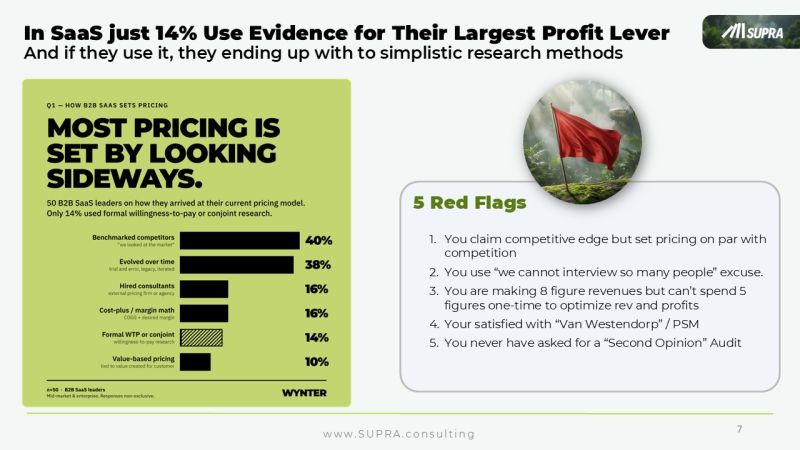
Who set your current price?
Not the pricing page. The number on it. Who decided it, and based on what evidence?
If the honest answer contains "we looked at what competitors charge", "we added a margin on top of costs", or "it felt right at the time"… you're running your most powerful profit lever on guesswork.
You're not alone. The evidence is clear: most pricing strategies are made by guesswork. Not by lazy people, by smart teams who were never handed a better method.
And the timing could not be worse. As AI drives up the cost of delivering software, pricing is becoming, even in SaaS, the ultimate profit and growth lever. Or the ultimate barrier. Which one it becomes for you depends on whether you can spot these five red flags.
Why Pricing Beats Everything Else on Your To-Do List
Here's a piece of arithmetic every CFO knows and most product teams ignore: a price improvement flows straight to the bottom line. There is no cost of goods attached to it. No extra servers, no extra support tickets, no extra sales headcount.
Raise volume by 1% and you also raise costs. Cut costs by 1% and you eventually cut into muscle. Improve price by 1% and every cent lands on profit.
That makes pricing the single most effective topic you can spend time on.
It is also, in most SaaS companies, the least examined. Product gets roadmaps and rituals. Marketing gets dashboards and attribution debates. Pricing gets… a Slack thread once a year.
So check these five red flags. Each one is a symptom of the same underlying disease: strategy built without valid insight into what actually drives willingness to pay.
The Five Red Flags
Red Flag #1: Your price is a historical accident
The most common pricing strategy in SaaS is inertia.
The price was set at launch, under time pressure, anchored on a guess, and then it survived. Three funding rounds later, the product does five times more, the market has moved twice, and the price point is the same number someone typed into a slide in a hurry.
Ask around: nobody owns it. Nobody remembers the reasoning. Nobody can point to the evidence behind it, because there wasn't any.
A price nobody can justify is not a strategy. It's an artifact.
Red Flag #2: You default to cost-plus or competitor-copy
When companies do actively set prices, two defaults dominate. Both feel rigorous. Both are guesswork wearing a suit.
Cost-plus starts from your costs and adds a margin. The problem: your customer does not care about your costs. Willingness to pay is driven by the value the customer perceives, and in SaaS, where marginal cost has historically been near zero, cost-plus systematically underprices the value you create. Ironically, now that AI usage is pushing delivery costs up, cost-plus flips into the opposite failure: it pushes prices up without any evidence the market will follow.
Competitor-copy feels safer. It isn't. Your competitor's price was set by a team just like yours, under time pressure, anchored on a guess. When you copy their price, you're not importing their strategy.
You're importing their mistakes.
Red Flag #3: Your willingness-to-pay "research" asks instead of validates
Some teams do commission pricing research. Then they run Van Westendorp, four hypothetical questions about which prices feel too cheap, cheap, expensive, and too expensive.
Understand what this method actually measures: what people say sounds reasonable. Not what they would pay. Not what they will do at the moment of purchase. And. This is the part that should alarm you. It contains no profit logic whatsoever. Van Westendorp can hand you an "acceptable price range" that leaves enormous margin sitting on the table, and it will never tell you.
A method that ignores margin cannot optimize margin. Wrong remains wrong, no matter how established the chart looks.
If you want to see how the main approaches compare, and where each one quietly fails, start with our practical comparison of pricing research methods.
Red Flag #4: Nobody has causally validated willingness to pay
This is the deepest flag, and the one the other four grow out of.
Great strategies require insights into the causal mechanisms of the market: what actually causes a customer to pay more, stay longer, upgrade sooner. Not what correlates with it. Not what a dashboard shows happened last quarter. What causes it.
Most pricing decisions are built on stated opinions and descriptive statistics, data that tells you what happened, never why. Build a price on that, and you are building on sand. The validity of your insights is the foundation everything else stands on. Without it, the strategy fails, the implementation fails, and everyone downstream works hard on the wrong number.
Validated causal evidence, the core of a decision-intelligence approach to pricing, replaces the guess with a quantified answer: which price moves are safe, which are risky, and what each one is worth.
Red Flag #5: Pricing is a project, not a process
The final red flag: your last pricing initiative has an end date.
A repricing project every three years treats pricing like a renovation. But the market doesn't hold still between renovations. Competitors move. Costs move, in the AI era, monthly. Your product's value moves with every release. A price validated three years ago is a guess today.
The companies that win treat pricing as a standing capability: continuously monitored, re-validated, and adjusted, across the whole portfolio, not just the flagship tier. That includes the price architecture across your range: how tiers, add-ons, and packages relate to each other is often worth more than the headline price itself.
The 60-second self-check
- Can anyone in the company explain the evidence behind your current price?
- Was the price derived from customer value, or from costs and competitors?
- Did your last pricing research include any profit logic, or just "acceptable" ranges?
- Has willingness to pay ever been validated causally, not just asked about?
- Is pricing reviewed continuously, or was the last serious look more than a year ago?
Two or more "no" answers? You have found the most effective topic you can spend time on this quarter.
What the Fix Looks Like
Notice what all five red flags have in common. None of them is an execution problem. Your team isn't failing to implement the pricing strategy.
There is no strategy. There is a guess with a governance process around it.
The fix starts one level below strategy: invest in the validity of the insights underneath. Measure what actually drives willingness to pay in your market, causally, quantified, per segment. Then let the strategy follow from evidence instead of anchoring on habit.
Companies that do this stop debating pricing in the abstract. They know which moves are worth what. Uncertainty disappears, and with it, the reflexive discounting and the fear of touching the pricing page.
Better insights → better strategy → more profit from the same product.
This is how you 10x your pricing.
SaaS pricing red flags: frequently asked questions
Why is guesswork pricing so common in SaaS?
Because SaaS prices are usually set once, at launch, under time pressure, anchored on a competitor or a cost calculation, and then never revisited with evidence. The number survives for years as a historical accident. The pattern isn't laziness; it's the absence of a method. Teams never had a way to validate willingness to pay causally, so gut feel and competitor-copy filled the gap.
What is wrong with Van Westendorp for SaaS pricing?
Van Westendorp asks four hypothetical questions about acceptable prices. It measures what respondents say sounds reasonable, not what they would actually pay, and not what maximizes your margin. The method contains no profit logic: it can call a price "acceptable" while leaving enormous margin on the table. Treat it as a rough screening tool at best, never as the basis for a pricing decision.
How do you validate willingness to pay causally?
By modeling what causes customers to pay more, instead of asking them or reading correlations off dashboards. Causal AI takes behavioral and contextual data, usage, competitive alternatives, buying situation, and isolates the true drivers of willingness to pay, quantified per segment or account. That turns pricing from opinion into evidence: you know which price moves are safe, which are risky, and what each is worth.
How often should SaaS companies revisit pricing?
Continuously, pricing is a process, not a project. Markets, competitors, costs, and product value shift every quarter, and in the AI era faster than that. A price validated three years ago is a guess today. High performers treat pricing and price architecture as a standing capability: monitored, re-validated with causal evidence, and adjusted as the market moves.
Dr. Frank Buckler advises leadership teams on growth decisions that depend on why customers choose. He founded SUPRA, holds a PhD in marketing and was among the first to apply causal AI to marketing questions. His latest book is THE TOP 5%.
