

Most companies treat pricing like a settings menu.
Open it once a year. Adjust a few numbers. Close it and get back to "real" strategy work.
That view isn't wrong. It's just half the picture. And the half you're missing is where the biggest money sits.
The Tactical Half: Fast, Measurable, Underused
Let me be clear about one thing first: tactical pricing is genuinely powerful.
Optimizing your price points, your discount structure, your packaging with real insights is one of the fastest ways to improve margins and revenue that exists in business. No factory to build. No product to reinvent. You change a number, and the P&L responds within a quarter.
That's why pricing work pays for itself faster than almost any other initiative. And why choosing the right pricing research method, one that measures what customers will actually pay, not what they claim they'd pay, matters so much.
So yes: do the tactical work. It's a great, fast way to improve margins.
But here's the thing…
The strategic dimension can be even more important.
The Assumption Hiding in Your Pricing Model
Every tactical pricing exercise contains a silent assumption: that the market price is a given. A fact of nature. Something you measure, like the weather, and then optimize around.
Find the willingness-to-pay. Position yourself against it. Done.
This assumption is wrong.
The market price is not the weather. It's the current score in a game, a game that you and every competitor are playing whether you realize it or not. Every price move, every product launch, every brand campaign shifts what customers consider a "normal" price for the category. And every one of those shifts provokes reactions from the other players.
I call this the Dynamic Market Game. Pricing is not a snapshot you optimize. It's a sequence of moves in a market that responds.
The market price is, long term, not a given. It can be nurtured.
Nurtured Is the Right Word
Think of a farmer looking at poor soil.
The tactical farmer optimizes within the constraint: pick the crop that survives, squeeze out the best yield this season. Sensible. Profitable, even.
The strategic farmer does something else. She builds the soil. Season after season, compost, cover crops, patience. Five years later she's growing crops the tactical farmer considers impossible on "this kind of land."
The land didn't change. The way she played it did.
Willingness-to-pay works the same way. It looks fixed on any given day. Over years, it's remarkably movable, if you work the levers that actually cause it to move.
What the Strategic Game Looks Like in Practice
What does it mean, concretely, to nurture a market price? Three moves stand out.
Move 1: Raise the reference price, not just your price
Customers don't evaluate prices in a vacuum. They evaluate them against a reference, what the category "should" cost. That reference is learned, and it can be re-taught. This is exactly what successful premium brands do: they don't sneak price increases past customers, they systematically build the perception that justifies them. How premium brands raise prices is a masterclass in playing the long game.
Move 2: Use your range as a game board
Your product portfolio is not a list. It's an architecture that shapes how every single price in it is perceived. A well-designed top-of-range product doesn't need to sell in volume, its job is to reframe what the mid-range costs. A carelessly priced entry product can quietly anchor your whole brand downward. Price architecture across your range is where tactical and strategic pricing meet.
Move 3: Anticipate the counter-move
In a dynamic game, your move is only as good as your read of the response. Will competitors follow your increase, lifting the whole category's price level, or undercut you? The answer depends on causal structure: their cost position, their brand strength, what their customers actually value. Companies that model this play chess. Companies that don't play darts. Blindfolded.
Signs you're only playing the tactical game
- Pricing is reviewed once a year, usually as a cost-pass-through exercise.
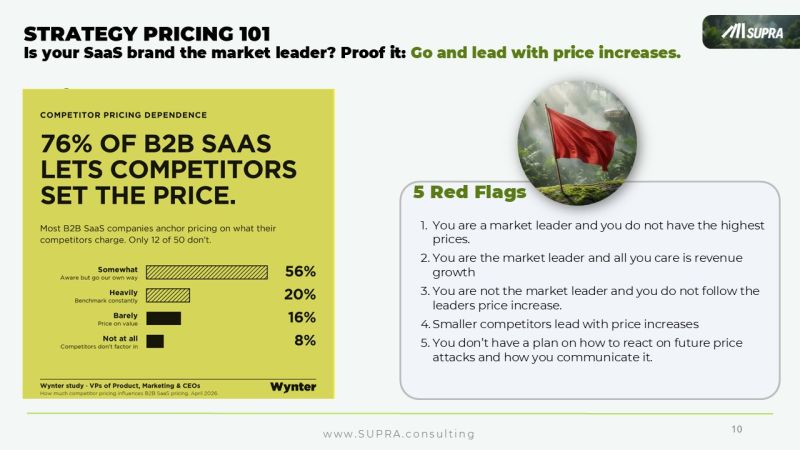
- Your "market price" comes from competitor benchmarks, treated as immovable fact.
- Nobody owns the question of how to grow willingness-to-pay over a 3-year horizon.
- Price architecture across your range grew historically instead of being designed.
- Competitor reactions to your last price move surprised you.
Why Most Companies Never Play
If the strategic game is so valuable, why does almost nobody play it?
Because it requires something most pricing processes don't have: causal understanding.
Tactical pricing can survive on decent measurement. The strategic game cannot. To nurture a market price, you need to know which levers cause willingness-to-pay to grow, brand associations, product signals, range architecture, category framing, and which merely correlate with it. Guess wrong, and you invest years of effort into levers that move nothing.
This is precisely what decision intelligence for pricing is built for. Causal AI separates the drivers from the passengers. It tells you not just where willingness-to-pay stands today, but what would make it different tomorrow, quantified, so you can play the game deliberately instead of hopefully.
Tactical pricing optimizes under the ceiling. Strategic pricing raises it.
Play Both Games
This is not an either-or. The companies that win at pricing run both clocks at once.
The fast clock: continuous tactical optimization, price points, discounts, packaging, powered by valid measurement of what customers will pay. Margin gains within quarters.
The slow clock: deliberate moves that grow the market's price level itself, reference prices, range architecture, brand-driven willingness-to-pay. Gains that compound over years, and that competitors can't copy with a spreadsheet.
The tactical game improves your position in the market. The strategic game improves the market itself.
This is how you 10x your pricing.
Pricing as a dynamic market game: frequently asked questions
What is the difference between tactical and strategic pricing?
Tactical pricing optimizes within today's market: finding the price points, discount structures, and packaging that maximize margin given current willingness-to-pay. Strategic pricing changes the market itself: shaping reference prices, category perception, and willingness-to-pay over years. Both matter. Tactical work delivers fast margin gains, but the strategic dimension can be even more important, because it moves the ceiling the tactics operate under.
What does it mean that pricing is a dynamic market game?
It means the market price is not a fixed external condition but the current state of a game played by all market participants. Every price move, product launch, and brand signal shifts what customers accept as normal, and competitors respond in turn. Companies that treat price as a given only react. Companies that understand the game can nurture the market price level in their favor over time.
Can the market price really be influenced long term?
Yes. Long term, the market price is not a given. It can be nurtured. Premium brands demonstrate this constantly: through brand building, deliberate price architecture across a range, and consistent signaling, they raise the reference price customers consider normal. What looks like an immovable market condition is really the accumulated result of past moves.
How does SUPRA approach strategic pricing decisions?
SUPRA combines causal pricing research with decision intelligence. First, Causal AI identifies what actually drives willingness-to-pay in your category, not what merely correlates with it. Then those causal insights feed both levels of the game: tactical optimization for fast margin gains, and strategic moves that grow the price level of the market itself. The foundation is always evidence of causal mechanisms, not stated preferences or benchmark guesswork.
Dr. Frank Buckler advises leadership teams on growth decisions that depend on why customers choose. He founded SUPRA, holds a PhD in marketing and was among the first to apply causal AI to marketing questions. His latest book is THE TOP 5%.
