

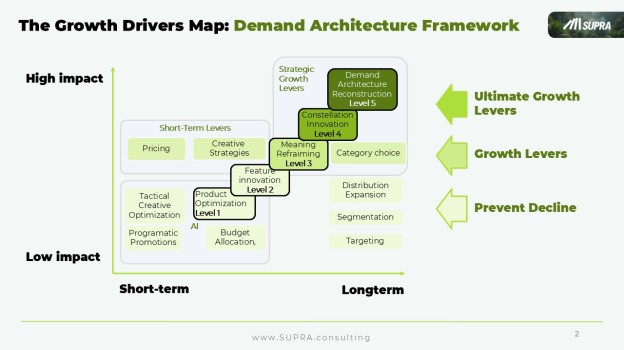
Marketing seems increasingly complicated and complex.
It is. Media mix modeling, performance marketing, segmentation, brand tracking, creative testing, pricing, innovation pipelines, retail media, first-party data… the list of things a "modern marketer" is supposed to master grows every quarter.
And here is the paradox: if you respond to that complexity by trying to be a perfect marketer, good at all of it. You will end up with bad marketing and low growth.
Not despite your diligence. Because of it.
Why Perfection Everywhere Means Mediocrity Everywhere
The logic is simple, and it's economic, not motivational.
Exceptional results in any marketing subdomain require mastery in that subdomain. Not familiarity. Not a competent agency on retainer. Mastery, the level where you see options your competitors can't.
And mastery is expensive. In talent, in tools, in leadership attention. Having that level of mastery in every domain is prohibitively expensive for any organization I've ever seen, including the giants.
So the marketer who tries to do everything well ends up doing everything at 70%. And in marketing, 70% everywhere doesn't average out to decent results. Because impact isn't distributed evenly across domains. It's concentrated in a few. Being mediocre in a high-leverage field while polishing a low-leverage one isn't balance.
It's waste, dressed up as professionalism.
I call this the Perfect-Marketer Paradox: the more evenly you spread your pursuit of excellence, the less excellence you can afford anywhere it matters.
The Multipliers Beat the Optimizers
How unevenly is impact distributed? Look at the pairs.
MMM vs. creative strategy
A well-run marketing mix modeling exercise may increase your marketing impact by 50%. That's huge, genuinely worth doing.
An evidence-based creative strategy sometimes 5-to-10x's your impact.
Same company. Same budget. One lever reallocates spend across channels; the other changes what the spend says. The second dwarfs the first, yet most organizations invest ten times more sophistication in the media model than in the creative decision.
Segmentation vs. category choice
A motivational segmentation may help you become more tuned to your groups. Useful.
The right choice of a growing category will flood in growth on autopilot, year by year. A rising tide you selected on purpose. No targeting matrix ever compounded like a growing category does.
Performance tweaks vs. price strategy
Tweaking your performance marketing playbook may cut your CAC in half for a few weeks, before it bounces back. The auction adjusts, competitors copy, the arbitrage closes.
A proper price strategy and price setting can in some cases double profits. In weeks. And unlike the CAC tweak, the effect doesn't evaporate, because it's built on how customers actually value your offer, not on a temporary market inefficiency.
Feature optimization vs. demand architecture
Innovation has the same split. It's comforting, and easier, to optimize existing products: add features, flavors, packaging variants. The roadmap fills itself.
But true growth comes when you dare to architect demand: shape your offering around a simple, solid understanding of customers' unconscious goals and the contexts in which those goals are active. That's a different sport. It requires clarity most brands never invest in, and it's the sport where the outsized returns live.
The pattern in one box
- Optimizers improve outcomes by percentages: MMM (+50%), performance tweaks (temporary CAC cuts), feature add-ons.
- Multipliers change outcomes by multiples: creative strategy (5–10x), price strategy (profits doubled in weeks), category choice (compounding growth), demand architecture.
- Mastery is affordable in one or two fields. Choose fields from the second list.
T-Mobile: One Insight, One Decade of Growth
Does this actually work outside of frameworks and blog posts?
T-Mobile has shown sustainable growth since 2013. In US telecom, one of the most commoditized industries on the planet, where every player sells the same network coverage at the same price points with the same handsets.
How?
They constructed their demand architecture on a single, simple, powerful insight: people want agency, and they will oppose brands that overuse their market power.
Customers felt trapped by contracts, gouged by fees, talked down to by incumbents. T-Mobile positioned itself as the "Un-carrier": the brand on the customer's side against an industry that had stopped pretending to be. Every move, killing contracts, abolishing overage fees, was the same sentence spoken in a new way.
Here's the part most retellings skip: this insight was not a lucky slogan. It was carefully vetted, and validated with Causal AI. The demand architecture came first, tested and quantified. And once that clarity existed, execution was straightforward. Not easy. Straightforward. Everyone in the company could check any initiative against one question: does this give customers more agency?
That's what mastery in one high-impact field looks like. Not a thicker playbook.
A sharper spearhead.
Complexity Is Real. Your Response to It Is a Choice.
I'm not telling you marketing is secretly simple. It isn't. The complexity is real, and it grows.
I'm telling you that the winning response to complexity is not coverage. It's prioritization. Pick the one or two fields where mastery would multiply your growth. Build genuine, uncomfortable, expensive mastery there. Run everything else at competent-and-cheap.
The perfect marketer optimizes everything and multiplies nothing.
The top 5% multiply one thing, and let the rest be good enough.
The five levels of the Demand Architecture Framework are my answer to the obvious next question: which field, and how to build the clarity that makes execution straightforward.
This is how you 10x your marketing impact.
The Perfect-Marketer Paradox: frequently asked questions
What is the Perfect-Marketer Paradox?
The Perfect-Marketer Paradox says that trying to be good at every marketing subdomain produces bad marketing and low growth. Exceptional results only come from mastery within a subdomain, and building mastery in every domain is prohibitively expensive. Spreading budget and attention evenly guarantees mediocrity everywhere. The solution is prioritizing the few fields where mastery multiplies impact and accepting competence in the rest.
Which marketing levers have the highest impact on growth?
The multipliers beat the optimizers. A marketing-mix-modeling exercise may raise impact by around 50%, while an evidence-based creative strategy can 5-to-10x it. Performance-marketing tweaks may halve CAC for a few weeks before it bounces back, while proper price strategy can in some cases double profits within weeks. And architecting demand around customers' unconscious goals compounds growth year after year.
How did T-Mobile grow sustainably in a commoditized market?
T-Mobile has shown sustainable growth since 2013 in US telecom by building its demand architecture on one simple, powerful insight: people want agency and will oppose brands that overuse their market power. The Un-carrier positioning made T-Mobile the customer's advocate against the incumbents. Critically, the insight was carefully vetted and validated with Causal AI before execution, and with that clarity, execution became straightforward.
How do I decide which marketing field to prioritize?
Compare levers by their realistic impact multiple, not by how familiar or comfortable they feel. Optimization work typically improves outcomes by percentages; strategic work, creative strategy, pricing, category choice, demand architecture, can multiply them. SUPRA's Demand Architecture Framework and Growth Diagnostic exist precisely to identify which one or two fields hold the largest untapped multiple for your brand.
Dr. Frank Buckler advises leadership teams on growth decisions that depend on why customers choose. He founded SUPRA, holds a PhD in marketing and was among the first to apply causal AI to marketing questions. His latest book is THE TOP 5%.
