

Apple just raised prices on average by 26%.
APPLE. The brand that is already leading tech premium prices. The brand everyone assumed had already squeezed every drop out of willingness to pay.
Sit with that for a second. The most professionally priced brand in tech looked at its own price points, the highest in the category, and concluded there was still 26% of headroom.
Now the uncomfortable question: if Apple can find 26% above the top of the market… what are you leaving on the table below it?
How Most Brands Actually Manage Pricing
Here's the dirty secret of pricing: most brands do not manage it professionally enough.
They fall into one of two camps.
Camp one: no research at all. Price is set by cost-plus habit, by last year's list plus inflation, or by nervously shadowing the competitor. Pricing, the single most powerful profit lever in the business, is run on gut feeling.
Camp two: generic research. A standard survey, a quick sensitivity check, a template method from a research agency menu. It feels rigorous. But generic research often gives costly signals, numbers that point confidently in the wrong direction.
Both camps produce the same outcome: prices that are systematically too timid, and profit that quietly evaporates year after year.
The Pet Brand That Tripled Profits
Let me show you what professional pricing research reveals instead.
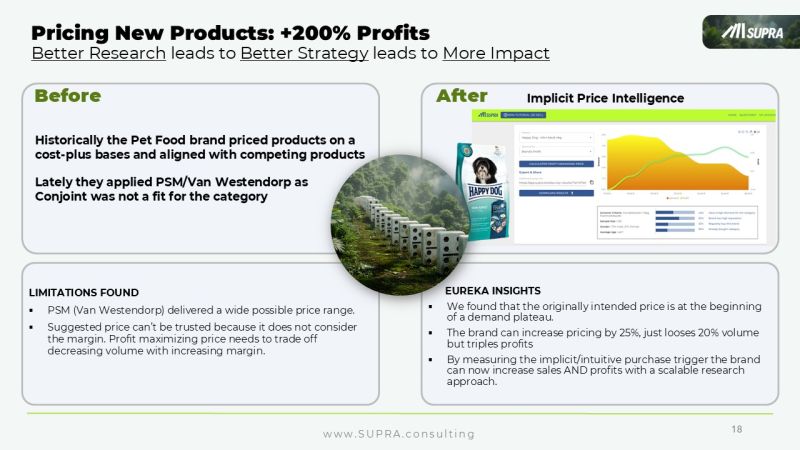
A pet brand we worked with wanted to know its real pricing headroom. The analysis found that increasing prices by 25% would reduce demand by 20%.
Sounds scary, right? Losing a fifth of your buyers?
Look again. That same move would TRIPLE profits.
The arithmetic is simple once you see it: the customers who stay pay substantially more, and the extra margin per unit dwarfs the contribution lost from the units that walk away. Demand down 20%, profit up 200%.
No manager's intuition gets this trade-off right, because intuition anchors on volume. Volume is visible. Margin structure is not. That's why professional pricing starts by modeling demand and margins together, and why brands that do it keep finding profit their competitors can't see. It's the same logic behind how premium brands raise prices without killing demand.
The Van Westendorp Problem
"But we did do pricing research," I often hear. "We ran a Van Westendorp."
Ah yes. The often-hyped Van Westendorp Price Sensitivity Meter. Four questions about what feels cheap, expensive, too expensive. A tidy chart with crossing lines. An "acceptable price range" that everyone in the room can agree on.
Here's the problem, and it's not subtle: Van Westendorp does not even consider margins.
Think about what that means. A method that never sees your cost structure is logically incapable of finding a profit-optimal price. Not "less precise." Not "a good first approximation." Incapable. It answers a question, "what price feels acceptable?". That is not the question your P&L is asking.
The pet brand's optimal move, plus 25% price, minus 20% demand, triple profit, is exactly the kind of answer Van Westendorp can never produce, because the profit tripling happens in a column of the spreadsheet the method doesn't know exists.
If you want to see how the main approaches compare, and which question each one can and cannot answer. I've laid it out in our guide to pricing research methods.
It's Your Job to Kick the Tires
It always strikes me that most CMOs are not seeing this.
Not because they're not smart. Because they've delegated the question. "The agency recommended Van Westendorp." "Our insights team handles methodology." "We're not technical people."
I understand. You can't be an expert in every technical detail, nobody expects you to derive elasticity curves before lunch.
But even if you're not into technical details, it's your job to kick the tires.
Because a great strategy built on bogus insights is a castle built on sand. You can hire the best strategy minds in the world, and if the willingness-to-pay number underneath is wrong, everything they build on it is wrong too, beautifully, expensively wrong.
Kicking the tires doesn't require a PhD. It requires three questions.
Three questions that expose weak pricing research
- "Does this method model profit, including our margins, or only demand?" If margins aren't in the model, an optimal price cannot come out of it.
- "Does it measure real willingness to pay, or what people say about prices?" Stated price perceptions are stories. Behavior-based and causal methods measure the decision itself.
- "Has this approach been validated against actual market outcomes?" If the honest answer is "it's a widely used standard," you've learned it's popular. Not that it's right.
Ask these three questions in your next pricing meeting and watch the room carefully. The reaction tells you everything about the foundation your prices stand on.
The Apple Standard
Apple's 26% move isn't interesting because of the number. It's interesting because of what it signals: a company that treats price as a precision instrument, informed by a deep understanding of the value its brand holds in customers' minds, value customers themselves couldn't articulate in any survey.
That's the standard. Not Apple's prices, Apple's process.
So: are you managing your prices as professionally as Apple manages theirs?
If the honest answer is no, the gap between your current price and your optimal price is where your next years of profit growth are hiding. For the complete playbook on how brands join the small group that grows systematically, have a look at my new book THE TOP 5%.
Price on evidence, not on nerve. This is how you 10x your profit lever.
Professional pricing: frequently asked questions
Why did Apple raise prices by 26% if it already leads premium pricing?
Because professionally managed brands treat price as a strategic instrument, not a fixed setting. Apple raised prices on average by 26% from the top of the tech premium market, a move only possible when a company understands its true price elasticity and the implicit value its brand carries. The lesson for other brands: pricing headroom is usually larger than intuition suggests, but only rigorous causal pricing research can locate it safely.
Can a price increase reduce demand and still triple profits?
Yes. In a SUPRA pricing project, a pet brand found that increasing prices by 25% would reduce demand by about 20%, and still triple profits. The mechanism is margin arithmetic: when the extra margin per unit outweighs the units lost, profit rises steeply. This is why optimizing for demand or revenue alone misleads. Professional pricing research models demand and margin together to find the profit-optimal price, the approach behind how premium brands raise prices.
What is wrong with the Van Westendorp pricing method?
Van Westendorp's Price Sensitivity Meter asks consumers directly what prices feel cheap, expensive, or too expensive. Beyond relying on stated perceptions, it has a structural flaw: it does not consider margins at all. A method that never sees your cost and margin structure is logically incapable of finding a profit-optimal price. SUPRA treats Van Westendorp as at best a rough perception check, never as the basis for a pricing decision.
How should a CMO evaluate pricing research without being a methods expert?
Kick the tires with three questions: Does the method model profit, including margins, or only demand? Does it capture real willingness to pay rather than stated price perceptions? And has it been validated against actual market behavior? A CMO doesn't need technical depth to ask these, but skipping them means building strategy on sand. SUPRA's comparison of pricing research methods shows which approaches pass all three tests.
Dr. Frank Buckler advises leadership teams on growth decisions that depend on why customers choose. He founded SUPRA, holds a PhD in marketing and was among the first to apply causal AI to marketing questions. His latest book is THE TOP 5%.
