

CEOs and CMOs, let's start with the one thing we agree on: pricing is your fastest short-term lever to profitable growth.
No new product needed. No campaign to produce. No twelve-month roadmap. Move the price and package architecture, and the P&L moves within weeks.
But every great strategy requires great clarity.
And this is exactly where it falls apart. Because when companies want clarity on pricing, they reach for the standard tool: conjoint analysis. Respondents trade off feature bundles at different price points, the software estimates utilities, and out comes a simulator that looks like the truth.
It isn't the truth. It's a model of the truth, and the model has blind spots exactly where the money is.
A recent pricing project made this brutally concrete. Four of the most commercially important findings would have been invisible to conjoint. Not slightly distorted.
Invisible.
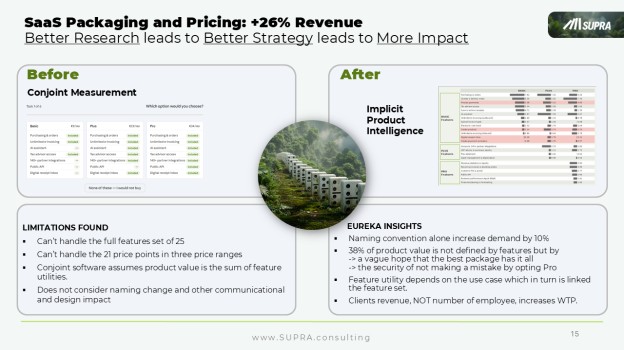
Insight #1: The Naming Convention Alone Increased Demand by 10%
Same features. Same prices. Different names on the tiers.
Result: 10% more demand.
Think about what that means. A lever that costs nothing to pull, no engineering, no discounting, no margin sacrifice, moved demand by double digits. Purely because names carry implicit meaning. A name frames the whole offer before a single feature is read.
Conjoint would have missed this entirely. In a conjoint design, the name is a neutral label, a container for the feature bundle underneath. The method assumes the label carries no utility of its own. But the intuitive mind doesn't read labels neutrally. It reacts to them in milliseconds, and that reaction shapes everything that follows.
A free 10% demand lift, sitting outside the model.
Insight #2: 38% of Product Value Wasn't Features at All
Here's the finding that should worry every product manager who has ever built a feature-priority matrix.
In this project, 38% of the perceived value of the top package was not defined by its features. It came from two things conjoint has no vocabulary for: a vague hope that the best package "has it all", and the security of not making a mistake by opting for Pro.
Hope and safety. Not speed, not storage, not support tiers.
Conjoint is built on an additive utility model: total value equals the sum of part-worths. Add a feature, add utility. But more than a third of the value here wasn't attached to any feature. It was attached to what the package meant, insurance against regret, permission to stop comparing.
If you had optimized this portfolio on conjoint output, you would have "rationalized" the Pro tier, stripped the redundant features, sharpened the price… and destroyed the very ambiguity customers were paying for.
Wrong remains wrong, even when the simulator says otherwise.
Insight #3: Feature Utility Depends on the Use Case
Ask conjoint what a feature is worth, and it gives you a number. One number.
But in reality, the same feature was highly valuable in one use case and nearly worthless in another. The utility wasn't a property of the feature. It was a property of the situation the customer was buying for.
This matters enormously for price and package architecture. If utilities shift by context, then the right architecture isn't one ladder of "good, better, best." It's a structure that maps packages to use cases, and prices each against the value in that context.
Standard conjoint averages across contexts and hands you a blended utility that describes nobody. It's like reporting the average temperature of a patient population: technically correct, clinically useless.
Insight #4: Pricing Power Has Indicators, And They Weren't the Obvious Ones
Every B2B pricing team segments willingness-to-pay by firmographics. The default proxy: company size, measured in employees.
In this project, the data said something different. Pricing power tracked revenue, not headcount. Two companies with identical employee counts had completely different willingness-to-pay, because what predicted it was the money flowing through the business, not the people in it.
Conjoint doesn't ask this question. It estimates preferences for the sample you recruited; it doesn't tell you which observable market indicators reveal where pricing power actually sits. That requires causal analysis of what drives willingness-to-pay across the market, the kind of modeling we do in decision intelligence for pricing.
Get this indicator wrong and your entire segmented price list discriminates on a variable that doesn't matter.
Top Consultancies Know Their Craft. But They Build on Sand.
Here's the uncomfortable part.
The big strategy consultancies are genuinely good at what they do. The frameworks are sharp, the workshops run on rails, the decks are beautiful. That's not the problem.
The problem is the input. When the insight layer underneath a pricing strategy comes from standard approaches, conjoint, stated willingness-to-pay, gut-feel segmentation, the strategy inherits every blind spot of those methods. Brilliant analysis on top of flawed evidence.
Exceptional strategy requires exceptional clarity.
Otherwise it's just great storytelling.
Four questions your pricing research must answer. That conjoint can't
- What do the names of your tiers do to demand, independent of features and price?
- How much of your top package's value is emotional, hope, security, regret insurance, rather than functional?
- How do feature utilities shift across use cases, and does your package architecture reflect that?
- Which observable indicators actually predict pricing power in your market, and have you tested them causally?
What to Do Instead
I'm not telling you to burn conjoint. For narrow trade-offs between well-understood, rationally evaluated attributes, it has its place, alongside the other tools in the pricing research toolbox.
I'm telling you not to build a strategy on it.
For high-stakes pricing decisions, you need two things conjoint cannot deliver. First, access to the implicit layer, the meanings, hopes, and anxieties that drive real buying decisions but never show up in a stated trade-off. Second, causal modeling that tells you which levers actually drive demand and willingness-to-pay, rather than which attributes correlate with stated preference in an artificial exercise.
When you have both, something remarkable happens: pricing stops being a defensive exercise in not leaving money on the table, and becomes an offensive lever. A naming change worth 10% of demand. A package architecture that protects 38% of value your competitors would have optimized away. A price list segmented on the variable that actually predicts pricing power.
That's the difference between researching prices and understanding demand.
This is how you 10x your pricing.
I unpack the thinking behind this, why standard methods keep missing what matters, and what the top performers do differently, in my new book, THE TOP 5%.
Conjoint and pricing research: frequently asked questions
What does conjoint analysis miss in pricing research?
Conjoint assumes value is the additive sum of feature utilities. It misses everything that doesn't fit that model: the demand impact of naming conventions, emotional value like the security of not making a wrong choice, feature utilities that shift by use case, and the market indicators that reveal where pricing power sits. In one SUPRA project, these blind spots covered four of the most commercially important findings.
Can product naming really increase demand by 10%?
Yes. In a recent SUPRA pricing project, the naming convention of the product tiers alone increased demand by 10%, with identical features and identical prices. Names carry implicit meaning that shapes how buyers frame the whole offer. Because conjoint treats names as neutral labels for feature bundles, this lever is invisible to it. Only research designed to measure implicit response can detect and quantify it.
When is conjoint analysis still useful?
Conjoint remains a reasonable tool for narrow trade-off questions between well-understood, rationally evaluated attributes, for example, fine-tuning price points within an already validated package architecture. It becomes dangerous as the foundation of a pricing strategy, because it cannot see non-feature value, context-dependent utilities, or implicit drivers. SUPRA treats it as one instrument among several, never as the source of strategic clarity.
What should replace conjoint for high-stakes pricing decisions?
A layered approach: first understand the implicit decision drivers, then model how price, packaging, naming, and context causally drive demand with Causal AI. This decision-intelligence approach to pricing quantifies levers conjoint can't represent, hope, security, use-case context, pricing-power indicators, and turns them into a price and package architecture you can defend.
Dr. Frank Buckler advises leadership teams on growth decisions that depend on why customers choose. He founded SUPRA, holds a PhD in marketing and was among the first to apply causal AI to marketing questions. His latest book is THE TOP 5%.
