

CEOs, CMOs: "good standard" market research can destroy the success of your strategic growth initiatives.
Not bad research. Not sloppy research. Good standard research, executed correctly, by competent people, using methods every textbook endorses.
We see this all the time. And at one electronics brand, it nearly happened again.
The Setup: Everything by the Book
The brand was preparing a strategic product launch. The research plan looked exactly like the one your team would probably draft:
Van Westendorp's Price Sensitivity Meter (PSM) to find the launch price. Four questions about when a price feels too cheap, cheap, expensive, too expensive. Plot the curves, read off the "optimal price point." Standard practice for decades.
Explicit questionnaires to identify adoption blockers. Show the product, ask what people like, what concerns them, whether they'd buy.
Nothing wrong with the execution. The methods were run cleanly.
The methods themselves were the problem.
What the Standard Toolkit Actually Delivered
PSM: a range, not a decision
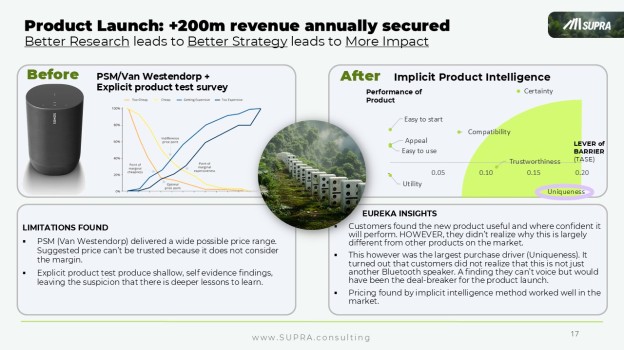
The Van Westendorp analysis delivered what it always delivers: a wide range of possible prices. Somewhere between "acceptable" and "acceptable," with an "optimal point" in the middle.
Here's the part the textbook doesn't emphasize: that suggested price can't be trusted. PSM does not consider margin. It optimizes for stated price acceptability, not for profit, not for positioning, not for the economics of your business. A price that maximizes the share of people who say a number feels fair can be a price that quietly destroys your P&L.
A range is not a pricing strategy. And a margin-blind optimum is not an optimum.
Explicit tests: shallow and self-evident
The explicit product tests produced findings that were… fine. Shallow, self-evident, the kind of results that make a steering committee nod and a strategist nervous.
Customers found the product useful. Customers were confident it would perform. Good news, right?
Except everyone in the room had the same nagging suspicion: there had to be deeper lessons to learn. When research only confirms the obvious, it hasn't measured the decision. It has measured the story customers can comfortably tell. That's the say-do gap at work, and no additional survey question closes it.
The Insight That Saved the Launch
So we went deeper, with implicit measurement and Causal AI, the core of our Deep Implicit Research framework.
What we found changed everything.
Yes, customers found the new product useful. Yes, they were confident it would perform. However. They didn't realize why it was largely different from other products on the market.
And here's the kicker: uniqueness was the largest purchase driver in this category.
Customers looked at a genuinely novel product and filed it away as just another Bluetooth speaker. They couldn't voice this, nobody writes "I fail to perceive this product's differentiation" in an open-ended survey field. It only surfaced when we measured implicit perceptions and let Causal AI identify which perceptions actually drive purchase.
An unvoiced misperception. Invisible to every explicit method. And it would have been the deal-breaker for the launch.
Think about what that means. The standard research said: useful product, confident customers, price somewhere in this range, go. The launch would have gone out without communicating the one thing that makes people buy. The product would have underperformed, and everyone would have blamed the product.
Wrong remains wrong, even when it's measured by the book.
And the price?
The pricing found by the implicit intelligence method, measuring willingness-to-pay past the say-do gap instead of asking four hypothetical questions, worked well in the market. Not a range. A price. One the business could defend on margin and the customer accepted at the shelf.
The Pattern Behind the Problem
This case is not an outlier. There is a pattern, and once you see it, you see it everywhere.
Strategy consultancies use "established market research" for one simple reason: insights is not their expertise. They need a defensible input for their frameworks, so they reach for the methods with the longest bibliography, PSM, explicit concept tests, stated-preference batteries. Defensible in a footnote. Unreliable in a launch.
The result: strategies built on data that describes what customers can say, not what makes them buy.
At SUPRA we come from the opposite direction. We know a working strategy requires deeper insights. That's why we blend world-class implicit research with marketing strategy expertise. Not research handed over the fence to strategists. One integrated view of why people adopt new products and what that means for your launch plan.
Before you greenlight a launch on standard research, check:
- Pricing: Did the method produce a decision or a range? Does it account for margin, or just stated acceptability?
- Drivers: Do you know which perceptions causally drive purchase in this category, or only what customers say matters?
- Perception vs. reality: Is your product's differentiation actually perceived? A real difference customers don't register is no difference at all.
- Depth: Do the findings surprise anyone? If every result is self-evident, the research measured the story, not the decision.
- Validation: Can the research predict whether the product will sell, or only describe attitudes toward it?
The Lesson for Your Next Launch
The most dangerous research isn't the study that fails visibly. It's the study that succeeds procedurally, clean fieldwork, established methods, plausible charts, while missing the one driver that decides the outcome.
This electronics brand got lucky: the deeper look happened before launch, not in the post-mortem. The uniqueness message went into the communication. The implicit price went on the shelf. The launch secured growth instead of explaining away a failure.
Your launch deserves the same depth.
Measure what drives the decision, not what survives a questionnaire. That's how you 10x your insights.
Launch research: frequently asked questions
Why is Van Westendorp unreliable for setting a launch price?
Van Westendorp's Price Sensitivity Meter delivers a wide range of acceptable prices, not a decision. Its suggested optimal price cannot be trusted because the method ignores margin entirely. It optimizes for stated acceptability, not profit. In SUPRA's electronics launch case, PSM produced a range too broad to act on; the price found through implicit intelligence methods, which capture willingness-to-pay past the say-do gap, worked well in the market.
Why do explicit product tests miss the real adoption blockers?
Because customers can only voice what they consciously know. Explicit questionnaires produce shallow, self-evident findings, usefulness, expected performance, while the decisive drivers stay hidden. In the electronics case, customers liked the product but did not realize it was fundamentally different from ordinary Bluetooth speakers. That unperceived uniqueness was the largest purchase driver, and no direct question could surface it.
How does implicit research find what customers cannot voice?
Implicit methods measure reactions instead of opinions, reaction-time-based association tests capture what the intuitive System 1 mind knows before the rational mind constructs an answer. Causal AI then infers which of those hidden perceptions actually drive purchase. SUPRA's Deep Implicit Research framework combines both, which is how it revealed that perceived uniqueness, a driver customers never mentioned, decided the electronics launch.
Is standard market research good enough for a strategic launch?
For low-stakes tracking, perhaps. For strategic growth initiatives, no. "Good standard" research, PSM pricing, explicit concept tests, systematically misses subconscious drivers and mis-prices new products. There is a pattern: consultancies default to established methods because insights is not their core expertise. SUPRA blends world-class implicit insights with marketing strategy expertise, because a working strategy requires knowing why customers really buy.
Dr. Frank Buckler advises leadership teams on growth decisions that depend on why customers choose. He founded SUPRA, holds a PhD in marketing and was among the first to apply causal AI to marketing questions. His latest book is THE TOP 5%.
