

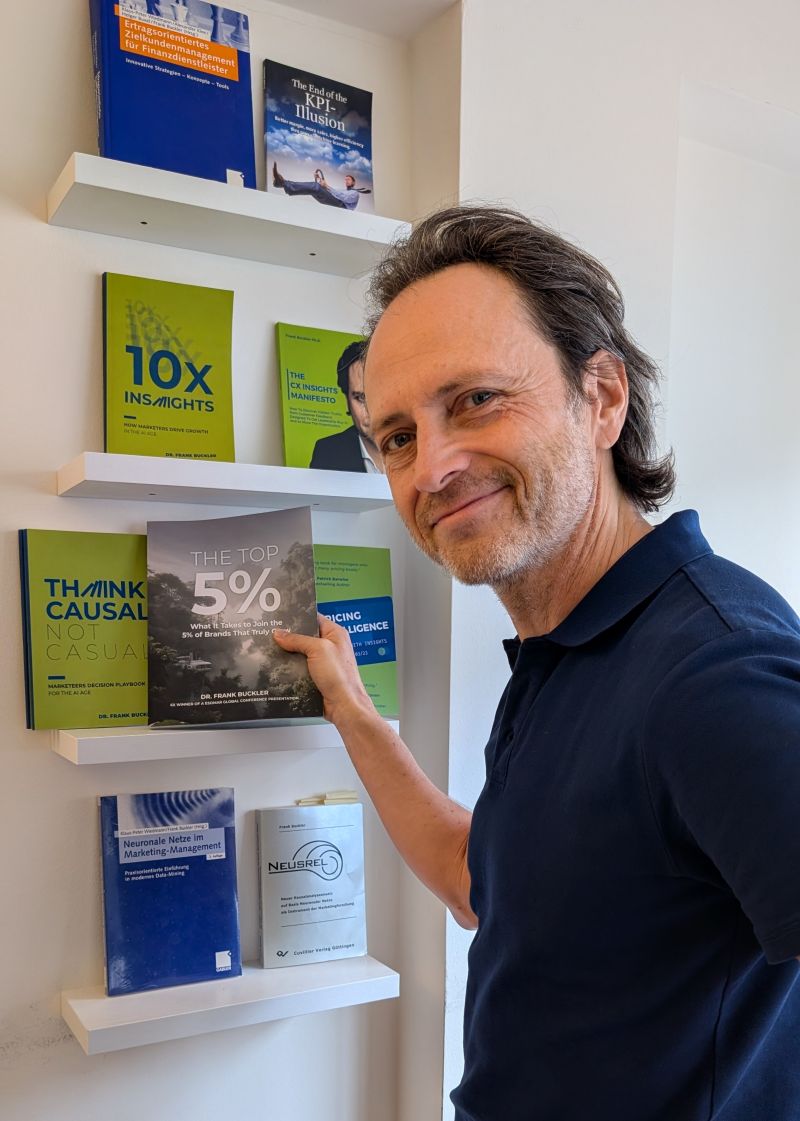
My new book is out.
A bit proud, a bit nervous, and very hopeful it will make people think differently about marketing. Because THE TOP 5% didn't start as a book project. It started as an itch.
An intuition that something is off in how we in marketing believe customers make buying decisions.
Not slightly off. Structurally off.
The Inconsistency Nobody Wants to Look At
Here's the itch, stated plainly.
For roughly 50 years, the mere exposure effect has been demonstrated again and again: people do not need to be consciously aware of something for it to increase their liking of it, and their likelihood of buying it. A stimulus you never consciously registered can still shape your preference. That's not a fringe claim. It's one of the most replicated findings in psychology.
And most of us know about System 1 and System 2. We've read Kahneman. We nod along: fast, intuitive, non-conscious System 1 does the heavy lifting; slow, rational System 2 mostly rationalizes afterward. We put it in our conference talks.
And then… we go back to the office and do the opposite.
We drive awareness so customers will consider us. We build funnels that assume a conscious mind moving deliberately from attention to interest to decision. We test messages by asking people what they consciously think of them.
Read those two paragraphs again. They cannot both be right.
If influence works without awareness, and 50 years of evidence says it does, then a marketing operating system built entirely on conscious awareness and consideration is measuring the wrong things, optimizing the wrong levers, and researching the wrong mind.
Something is not consistent. That sentence wouldn't let me go.
Down the Rabbit Hole
That intuitive discomfort drove me down a neuroscience rabbit hole. Not for a weekend. For years.
The question kept expanding. It started as: if buying decisions are made non-consciously, what does that mean? Then it became sharper: if this is true, how should research be done?
Because here's the uncomfortable implication: if the decisive processes run below awareness, you cannot access them by asking. A survey is a request for introspection. But System 1 doesn't answer surveys, System 2 does, and System 2 wasn't in the room when the decision was made. It only writes the report afterward. I've laid out that argument in detail in Why Market Research Is Broken.
So research has to change. It has to measure what people do and what they associate, not what they say. That conviction eventually became SUPRA's Deep Implicit Research framework: access the implicit layer, measure it properly, and infer causally what drives behavior.
And once the research question was answered, the final question opened up: how does all of this change the way we build brands? Launch products? Judge innovation? Create advertising that actually works, the heart of any creative strategy?
The book is my answer to that chain of questions.
Why Only 5% Succeed
Somewhere along that journey, a pattern snapped into focus.
Only about 5% of brands grow exceptionally. Only a sliver of product launches become lasting successes. Only a small fraction of ad creatives create significant growth. Everyone in the industry knows these numbers in some form. We treat them like weather, regrettable, unavoidable.
They're not weather. They're the logical consequence of something much simpler:
Same thinking, same outcome.
Think it through. If 95% of marketers share the same mental model, awareness drives consideration, benefits persuade, features add up, research means asking, then 95% of marketers will produce structurally similar strategies. Similar briefs. Similar campaigns. Similar launches. The distribution of outcomes follows the distribution of thinking.
You cannot copy your way into the top 5%. By definition.
The textbook is, by construction, the documentation of average practice. Execute it flawlessly and you get flawless average. The brands that break out aren't executing the standard model better. They're operating from a different model, one that starts with how the non-conscious mind actually decides, and builds brand, product, and creative decisions on that foundation.
Three signs you're running on the standard model
- Your KPIs start with awareness and consideration, and nobody has asked whether they causally drive sales in your category.
- Your research consists of asking people what they think, want, and would pay.
- Your briefs argue with benefits and features, as if customers compute a weighted score before buying.
Exceptional Outcomes Require Exceptional Thinking
I want to be precise here, because this is the sentence people misread.
This is not a call to be contrarian for its own sake. Different isn't automatically better. The point is that better is only available outside the standard model, because the standard model is what everyone already has. Exceptional outcomes require exceptional thinking. Not louder execution of textbook "wisdom."
And exceptional thinking isn't guesswork. That's the second misreading. The alternative to the textbook isn't gut feeling. It's a more accurate model of the customer, built on evidence: neuroscience, implicit measurement, causal analysis. The 5% aren't gamblers. They simply understand the game one level deeper.
That's what the book delivers. The inconsistency, laid bare. The neuroscience, made usable. The consequences for research, brand, innovation, and creative, worked out step by step, so you can rebuild your own thinking rather than borrow mine.
A bit proud, a bit nervous. Mostly hopeful.
Because if even a fraction of readers stops copying the average and starts thinking from first principles about how customers actually decide… the 5% gets bigger.
This is how you 10x your thinking.
THE TOP 5%: frequently asked questions
Why do only 5% of brands, launches, and creatives truly succeed?
Because almost everyone works from the same mental model: drive awareness, build consideration, persuade with benefits. When 95% of practitioners share the same thinking, they produce the same average outcomes, same thinking, same outcome. The 5% that break through operate from a different understanding of how buying decisions are actually made, one grounded in the non-conscious mind. That's the core argument of THE TOP 5%.
What is the mere exposure effect and why does it matter for marketing?
The mere exposure effect, demonstrated over roughly 50 years of research since Robert Zajonc, shows that people do not need to be consciously aware of a stimulus for it to increase their liking of it, and their likelihood of buying. This contradicts the standard marketing funnel, which assumes conscious awareness must precede consideration and purchase. If influence works without awareness, strategies and research built purely on awareness metrics measure the wrong thing.
If System 1 drives buying, how should market research change?
Research must stop relying on direct questioning, because System 1 processes are not accessible to introspection, respondents can only report the story their System 2 constructs afterward. SUPRA's Deep Implicit Research framework addresses this by measuring implicit associations and reaction times instead of stated opinions, and by using Causal AI to infer what actually drives behavior rather than what merely correlates with it.
What is THE TOP 5% about?
THE TOP 5% is Frank Buckler's book on why so few brands, product launches, and ad creatives achieve exceptional results. It traces the inconsistency between what neuroscience has proven about non-conscious decision-making and what marketers actually practice, then rebuilds the logic of brand, product, innovation, and creative impact from that foundation. Its central claim: exceptional outcomes require exceptional thinking, not better execution of textbook wisdom.
Dr. Frank Buckler advises leadership teams on growth decisions that depend on why customers choose. He founded SUPRA, holds a PhD in marketing and was among the first to apply causal AI to marketing questions. His latest book is THE TOP 5%.
