

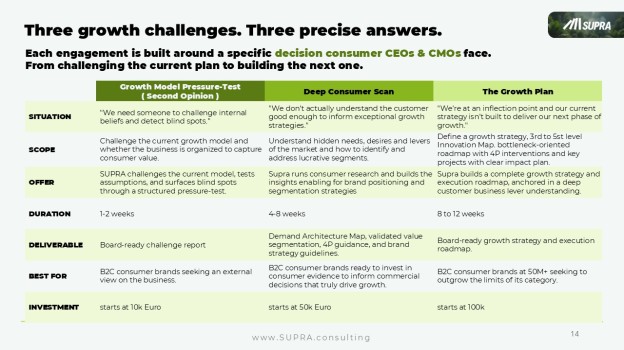
CEOs, CMOs: chances are that one of these three challenges bothers you.
Not in a vague, "business is hard" way. In a specific, structural way. After decades of working with leadership teams on growth, I keep meeting the same three situations, over and over, across industries, across company sizes.
The trouble is that from the inside, all three feel the same: growth is slower than it should be, and nobody can say precisely why.
But they are not the same. And treating one as if it were another is how companies burn a year and a consulting budget without moving the needle.
Let's take them apart.
Challenge A: The Strategy Is Right, The Execution Is Flawed
You have a strategy. You believe in it. The logic holds, the board bought in, the plans are written.
And yet the results lag the ambition.
Here's the uncomfortable truth about this situation: if the strategy is sound and the numbers aren't, there is a blind spot somewhere in the execution, and by definition, you can't see it. That's what makes it a blind spot. Your team can't see it either, because they're inside the same assumptions you are.
What you need is a pressure test. An outside-in, evidence-based examination of how the strategy translates into pricing, communication, product, and channel decisions, designed specifically to find the spot you're not seeing.
Not a second opinion. A stress test with data behind it.
Challenge B: The Strategy Isn't Built on Why Consumers Really Buy
This one is quieter. You have a strategy, but somewhere along the way, you've realized it isn't built on a deep understanding of why consumers really buy in your category.
Maybe it was built on last year's brand tracker. Maybe on a segmentation from three years ago. Maybe on the leadership team's collective experience, which is real, but which is also a story the company tells itself.
Most brands are in this position without admitting it. Nearly two decades of analyzing markets with Causal AI has taught us that most companies genuinely do not know their true purchase drivers. Customers can't voice them, and standard research can't measure them.
If the foundation is shallow, every floor above it wobbles. The fix here isn't better execution. It's rebuilding the insight foundation: understanding the real, often implicit, motivations that drive choice, and then constructing the demand architecture of your category on top of it.
Challenge C: The Strategy Did Its Job, And Is Now Obsolete
The third situation is the least discussed: you had a strategy, and it worked. It carried you through the last phase of growth.
But it's not fit for purpose for the next one.
The playbook that took you from 100 to 500 million rarely takes you from 500 million to a billion. The channels saturate. The early adopters are won. The competition has copied what used to be distinctive. You don't need a pressure test, and you don't just need deeper insight. You need an entirely new growth plan.
Different problems. Different solutions.
The good news: SUPRA's portfolio was built around exactly these three situations, a pressure test for Challenge A, a rebuilt insight foundation for Challenge B, and a full growth plan for Challenge C. If you want the short version of what actually drives growth across all three, start with the Top 5.
A 60-second self-diagnosis:
- Challenge A, "I trust the strategy, but the results don't follow." → You need a pressure test to find the execution blind spot.
- Challenge B, "If I'm honest, we don't really know why our customers buy." → You need a deep insight foundation before anything else.
- Challenge C, "The old plan worked. It just doesn't fit where we're going." → You need a new growth plan, not a patched old one.
- Not sure? That's normal, the challenges masquerade as each other. This is exactly what the AI Diagnostic is for.
What Happened When a Midcap CEO Took the Diagnostic
How do you find out which challenge is yours, objectively, not by gut feel?
We built a tool for that. A self-administered AI Growth Diagnostic on our website, free for anyone to use. The AI behind it is trained on my latest books, and it uses your self-assessment to spot the areas where your company will most likely be able to generate growth.
Recently, the CEO of a public midcap brand ran it. It always amazes me how spot-on the audit is, and this case was no exception.
He scored his brand excellent in most fields. Understandable: those were the fields he actively managed, measured, and invested in. And he scored mediocre in the fields he had consciously deprioritized.
Here's where it got interesting. The AI didn't just tally the scores. It sharply explained how one of the very things he had deprioritized might be a hidden lever, and illustrated why, in his specific situation, that neglected field was the most likely source of new growth.
I call this the Deprioritization Trap: your attention follows your past priorities, so your biggest opportunity hides exactly where you stopped looking. Excellent scores where you look. Mediocre scores where you don't. And the lever sitting quietly in the mediocre column.
No consultant flattery. No 200-slide deck. A pointed, evidence-based hypothesis about where growth lives, in minutes.
Why Diagnosis Must Come Before Prescription
Medicine figured this out centuries ago: the treatment depends on the diagnosis. Prescribe before you diagnose and you're not a doctor. You're a salesman with a pill.
Much of the consulting industry skips this step. The firm sells what the firm sells: the strategy house prescribes a new strategy, the agency prescribes a new campaign, the research vendor prescribes a new tracker. Whatever your disease, the pill is already chosen.
Joking aside, the sequence matters enormously. Pressure-testing a strategy that was never built on real purchase drivers is wasted rigor. Rebuilding insights when your actual problem is execution wastes a year. And patching an obsolete plan with either one just delays the reckoning.
Diagnose first. Then treat.
That's how you 10x the return on whatever you do next.
Growth challenges: frequently asked questions
What are the three growth challenges CEOs face?
Challenge A: you have a strategy but the execution is flawed. You need a pressure test to expose the blind spot. Challenge B: you have a strategy but it is not built on a deep understanding of why consumers really buy in your category. Challenge C: your strategy served its purpose but is not fit for the next phase of growth. You need an entirely new growth plan. SUPRA's portfolio addresses each with a distinct solution.
How does the SUPRA AI Growth Diagnostic work?
It is a free, self-administered assessment on supra.consulting. You score your business across growth-relevant fields; an AI trained on Dr. Frank Buckler's latest books analyzes the pattern of your answers and identifies the domains most likely to create growth in your specific case. It takes minutes, requires no sales conversation, and returns a written analysis, including levers you may have deprioritized.
What is the Deprioritization Trap?
The Deprioritization Trap is when leaders rate themselves excellent in the fields they actively manage and mediocre in fields they consciously deprioritized, while the deprioritized field is the hidden growth lever. A CEO of a public midcap brand experienced exactly this in SUPRA's AI Diagnostic: the AI showed how an area he had pushed aside was likely his biggest untapped opportunity, and illustrated why.
How do I know which growth challenge is mine?
Look at where conviction breaks down. If you trust the strategy but results lag, it is an execution problem, pressure test it. If you privately doubt the strategy reflects why customers actually buy, it is an insight problem, start with the demand architecture of your category. If the strategy worked but the company has outgrown it, it is a planning problem. If you are unsure, SUPRA's free AI Growth Diagnostic identifies which domains will create growth in your case.
Dr. Frank Buckler advises leadership teams on growth decisions that depend on why customers choose. He founded SUPRA, holds a PhD in marketing and was among the first to apply causal AI to marketing questions. His latest book is THE TOP 5%.
