

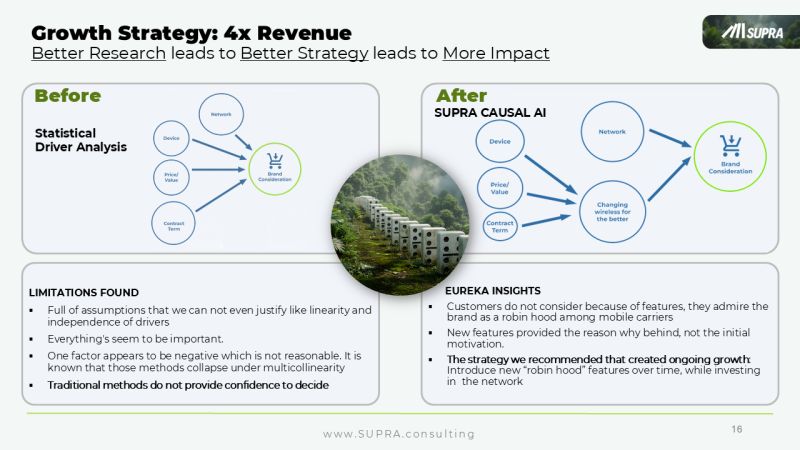
CEOs, CMOs, the right growth strategy can 4x revenue.
In a commoditized market.
Read that again. Not in a hot category with tailwinds. Not with a breakthrough product. In a market where every offer looks the same, every price gets matched within weeks, and every strategist in the room has quietly accepted that "growth" means stealing half a share point at ruinous cost.
How? Not with more expertise. Every serious player already has expertise. Not with more domain knowledge. Your competitors have been in this category as long as you have.
A powerful growth strategy runs on something else. A tiny detail that is almost always underleveraged.
Clarity and insights.
"Do Good Research" Sounds Trivial. It Isn't.
I can hear the objection. "Frank, of course. Do good research, survey your customers, understand how the market works. We know. We do that."
Hmm.
Nearly 20 years of analyzing markets with Causal AI and neuroscience taught us something uncomfortable: most brands do not fully understand why their customers buy.
Not "could refine their understanding." Do not fully understand. Including brands with large insights departments, annual tracking programs, and shelves of segmentation studies.
The reason is structural, not sloppy. Customers themselves don't know why they buy. Purchase decisions are made by the subconscious, intuitive mind, and rationalized afterward. So when your survey asks "why did you choose this brand?", you collect well-formed stories, not actual drivers. Stack a thousand stories and you get a statistically significant illusion.
And here's the part that should keep you up at night: if you don't get this fully right, all the strategy will be built on sand. The workshops, the positioning, the five-year plan, a beautiful building on a foundation nobody inspected.
Wrong remains wrong. No matter how good the execution on top of it.
What "Fully Right" Looks Like: The Un-carrier Case
Let me show you what happens when a brand does get it fully right, in the most commoditized market imaginable.
US mobile telecommunications, early 2010s. Four national carriers selling functionally identical network access. Same phones. Similar coverage. Price wars. And T-Mobile USA sitting in fourth place, the perennial also-ran.
The conventional read of that market: customers want cheaper plans and better coverage. Every carrier's strategy said some version of exactly that. That's what customers said in surveys, after all.
But the deeper truth of the market was different. Customers didn't just want cheaper. They felt exploited, locked into two-year contracts, blindsided by overage charges, trapped in fine print. Underneath the stated price sensitivity sat a powerful implicit motive: the desire for autonomy. For someone to take their side against the incumbents.
From 2013 onward, T-Mobile built its entire "Un-carrier" strategy on that insight. Kill contracts. Kill overage fees. Behave like the customer's advocate, loudly. Same commodity product underneath. Radically different demand being served.
The result: T-Mobile went from industry punchline to growth machine, multiplying its revenue in the years that followed, roughly 4x, while competing in a market everyone had written off as a zero-sum knife fight.
The product was a commodity. The demand never was.
That's the sentence to remember. Commoditization describes your offerings. It does not describe your customers.
Why Your Current Research Won't Find This
Here's the uncomfortable test: would your current research program have surfaced the "exploitation" insight?
Be honest. Your tracker would have shown price as the top stated driver. It always does in commodity markets. Your segmentation, if it's demographic or behavioral, would have sorted customers into buckets that all "want value for money." Your focus groups would have produced articulate complaints about pricing, because pricing is what people can articulate.
None of it would have quantified the thing that actually moved the market: a subconscious motive customers couldn't name, connected causally to switching behavior.
To find that, you need two things conventional research doesn't have:
The two ingredients of real market clarity
- Access to the subconscious. Implicit measurement captures the motives and associations customers can't report. This is what Deep Implicit Research is built for, measuring what people know before they think.
- Proof of causality. Correlation tells you price complaints and churn move together. Causal AI tells you whether fixing the contracts, not the price, is what actually changes behavior. Only one of those is a basis for betting your strategy.
Miss the first ingredient and you optimize what people say. Miss the second and you optimize coincidences. Miss both, the industry standard, and you get the strategies everyone else has.
From One Famous Case to a Repeatable Method
The T-Mobile story is inspiring. It's also dangerous, because famous cases invite exactly the wrong lesson: "hire a visionary."
Un-carrier wasn't a lightning strike of genius. It was a correct diagnosis of demand, executed with consistency. And a correct diagnosis is not luck. It's method.
That method is what we've codified at SUPRA as the Demand Architecture Framework. It maps the true structure of demand in your market, the functional and subconscious motives that drive buying, quantified causally, and then shapes your offering and positioning around the demand spaces nobody is serving.
The framework is replicable for any business. That's the point of a framework. Commodity or premium, B2C or B2B: wherever customers decide, there is a demand architecture underneath the decisions. Most of your competitors have never mapped it. Which means the map itself is a competitive asset.
It sounds almost unfair. It mostly is.
The $100M Question for Your Business
So here's the question I'd put to your leadership team.
If a fourth-place player in a brutal commodity market could 4x revenue by understanding demand better than its competitors… what is your organization's excuse for building strategy on stated survey answers?
You have the expertise. You have the domain knowledge. What's likely missing is the tiny, underleveraged detail: clarity about why your customers actually buy.
Get that fully right, and strategy stops being a debate of opinions. It becomes a set of simple, obvious moves, obvious only in hindsight to everyone else.
This is how you 10x your strategy.
Growth in commoditized markets: frequently asked questions
Can a brand really grow in a commoditized market?
Yes, commoditization describes the offerings in a market, not the customers. Even when products look interchangeable, customers carry unmet emotional and motivational demand that no player is serving. T-Mobile USA's Un-carrier strategy is the classic proof: in the hyper-commoditized US mobile market, it fueled a multiplication of revenue from 2013 onward. SUPRA's Demand Architecture approach is built to find exactly these hidden demand spaces.
Why do most brands not understand why their customers buy?
Because buying decisions are made subconsciously, while conventional research asks customers to explain themselves consciously. People report plausible stories, not real drivers. Nearly 20 years of analyzing markets with Causal AI and neuroscience taught us that most brands, even sophisticated ones, hold an incomplete or distorted picture of their true buying drivers. Strategy built on that picture is built on sand.
What is the Demand Architecture Framework?
The Demand Architecture Framework is SUPRA's science-backed method for shaping offerings and strategies around the true structure of customer demand. It combines Deep Implicit Research to surface subconscious buying motives with Causal AI to quantify which drivers actually move behavior. The output is a clear map of where demand is underserved, replicable for any business, not just the famous case studies.
How do I find out if my growth strategy is built on solid insights?
Test the foundation before trusting the building. Ask whether your driver evidence is causal or merely correlational, and whether it captures subconscious motives or only stated opinions. The fastest, lowest-risk way to check: take the AI Diagnostic on our website. It assesses where your current understanding of customer demand has gaps, before those gaps become an expensive strategy.
Dr. Frank Buckler advises leadership teams on growth decisions that depend on why customers choose. He founded SUPRA, holds a PhD in marketing and was among the first to apply causal AI to marketing questions. His latest book is THE TOP 5%.
