

Segmentation sounds so easy.
Cluster your customers. Give the clusters catchy names. Build a persona poster for each. Roll it out.
And then… nothing. In reality, most segmentations fail. Not at the analysis stage. Not at the strategy offsite. They fail in the one place that counts: implementation.
There's a reason for that. And it's fixable.
A Segmentation With Everything Going for It
We worked with a company that had done everything by the book.
They had hired a top management consulting firm. The firm delivered a full segmentation: frameworks, typologies, the works. Professionally built, professionally presented. Leadership signed off.
Then reality arrived.
The customer-typing tool took time. Classifying each customer was a chore squeezed between real work. And the results didn't always feel right, the people who actually knew the customers kept looking at segment assignments and thinking, that's not this customer at all.
Even worse: treating the segments distinctly took a lot of discipline. Different service approaches, different communication, different treatment, every single day, for every single customer, across the whole organization.
Discipline is a terrible foundation for a strategy. Discipline fades. And so the implementation faded out with it.
Millions in consulting fees. A segmentation nobody used.
The Two Design Flaws That Kill Segmentations
This story is not an outlier. It's the standard pattern. And underneath it sit two design flaws that almost every traditional segmentation shares.
Flaw 1: Segments built on correlation, not causation
Classical segmentation clusters customers on whatever variables happen to co-occur, demographics, attitudes, stated preferences. The clusters are statistically real. But statistically real is not the same as behaviorally meaningful.
If the properties defining a segment don't cause different buying behavior, then treating that segment differently changes nothing. You've organized your customers alphabetically, essentially, tidy, and useless. That's why segment assignments "don't feel right" to the front line: the front line sees behavior, and the segments weren't built on what drives it.
Flaw 2: The forced-assignment dogma
Traditional segmentation carries a silent rule: every customer must belong to a segment. The pie chart must sum to 100%.
Why?
Nobody ever gives a good answer. The rule exists because clustering algorithms produce it, not because businesses need it. And the price is enormous: forcing ambiguous customers into boxes maximizes misclassification, bloats the typing tool, and multiplies the daily discipline required to keep the system alive.
A segmentation that needs discipline to survive is a segmentation that was designed to die.
What We Did Differently
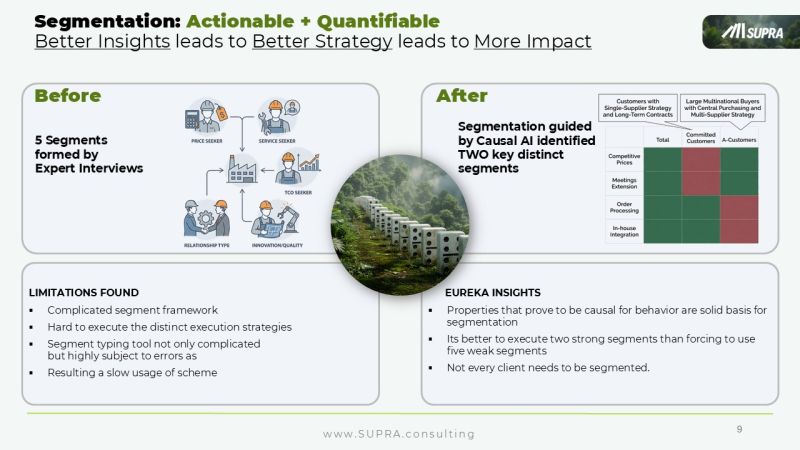
In our analysis, we started from the opposite end. Not "how do we cluster customers?" but "what actually causes customers to buy differently?"
Causal AI identified the customer properties, with great evidence. That cause different buying behavior. Not properties that correlate with it. Properties that drive it. Those causal properties signaled genuinely different need segments: groups of customers who buy differently because they need differently.
The same logic, by the way, applies far beyond acquisition. Understanding what causally drives churn is the mirror image of understanding what causally drives buying.
Then came the second break with tradition. We stepped away from the idea that each customer needs to be forced into a segment.
Instead, we focused on the most potent segments, the ones where distinct treatment demonstrably pays. The result:
The segmentation that actually got implemented
- Just 2 core value segments. Not seven personas with illustrated avatars. Two.
- Clearly identifiable. The front line could recognize segment membership without a cumbersome typing tool.
- Distinct service profiles. Each segment came with a concrete, different way of serving the customer, not a mood board.
- Causal evidence behind every boundary. Each segment existed because its defining properties demonstrably cause different buying behavior.
Suddenly the segmentation strategy had the support of the organization. Not because anyone mandated discipline, because the system was simple enough and true enough that using it was easier than ignoring it.
That's the whole trick. Implementation doesn't fail because people are lazy. It fails because the design demands more friction than it returns in value. Fix the design, and adoption follows. This is what created lasting impact.
If you want to go deeper on building segments around what actually moves customers, start with segmenting customers by motivation.
The Uncomfortable Lesson for Strategy Consulting
Here's the part that goes beyond segmentation.
Every great strategy lives and breathes by great insights, a fresh, meaningful view of your customers. Strategy is a conclusion. Insights are the premises. And a conclusion built on weak premises isn't a strategy…
It's a story.
The consulting firm in our case wasn't incompetent. The frameworks were sound, the slides were beautiful, the logic was internally consistent. What was missing sat one layer deeper: the customer insights underneath were built with traditional practices, clustering correlations, trusting stated answers, and so the whole elegant structure stood on sand.
Effective management consulting needs to include cutting-edge customer insights practices. Otherwise consulting degrades into great storytelling.
Great storytelling is pleasant in the boardroom. It's expensive everywhere else.
The fix isn't to fire your consultants. It's to upgrade the evidence layer they work from, causal, validated, implementable. That's the layer we build.
Better insights → better strategy → lasting impact.
This is how you 10x your strategy.
Do you need a second opinion on your actual market strategy?
Segmentation failure: frequently asked questions
Why do most segmentations fail in implementation?
Because they are built for the slide deck, not for the front line. Typical segmentations force every customer into a segment, rely on clunky typing tools, and produce clusters that don't always feel right to the people who know the customers. Treating segments distinctly then requires constant discipline, and discipline fades. Implementation succeeds when segments are causally grounded, few in number, and easy to identify in daily operations.
How does Causal AI improve customer segmentation?
Causal AI identifies the customer properties that actually cause different buying behavior, rather than clustering on characteristics that merely correlate. This produces segments with evidence behind them, genuine need segments, not statistical artifacts. In the client case above, Causal AI revealed which properties truly signaled distinct needs, which became the basis for a segmentation the organization could finally act on.
Does every customer need to be assigned to a segment?
No, and abandoning that assumption is often what saves the segmentation. Forcing every customer into a box maximizes classification errors and operational overhead. Focus on the most potent segments instead: in the case above, just two core value segments, clearly identifiable, each with a distinct service profile. Because the front line could apply it without friction, the strategy won organizational support and created lasting impact.
Why does management consulting need modern insights methods?
Because every great strategy lives and breathes by great insights, a fresh, meaningful view of your customers. When consulting is built on traditional research practices that capture correlations and stated opinions, the strategy on top is storytelling, however polished the deck. Effective consulting needs cutting-edge insights practices such as Causal AI and implicit measurement underneath, which is exactly the second-opinion layer SUPRA provides.
Dr. Frank Buckler advises leadership teams on growth decisions that depend on why customers choose. He founded SUPRA, holds a PhD in marketing and was among the first to apply causal AI to marketing questions. His latest book is THE TOP 5%.
