

Does sunscreen cause cancer?
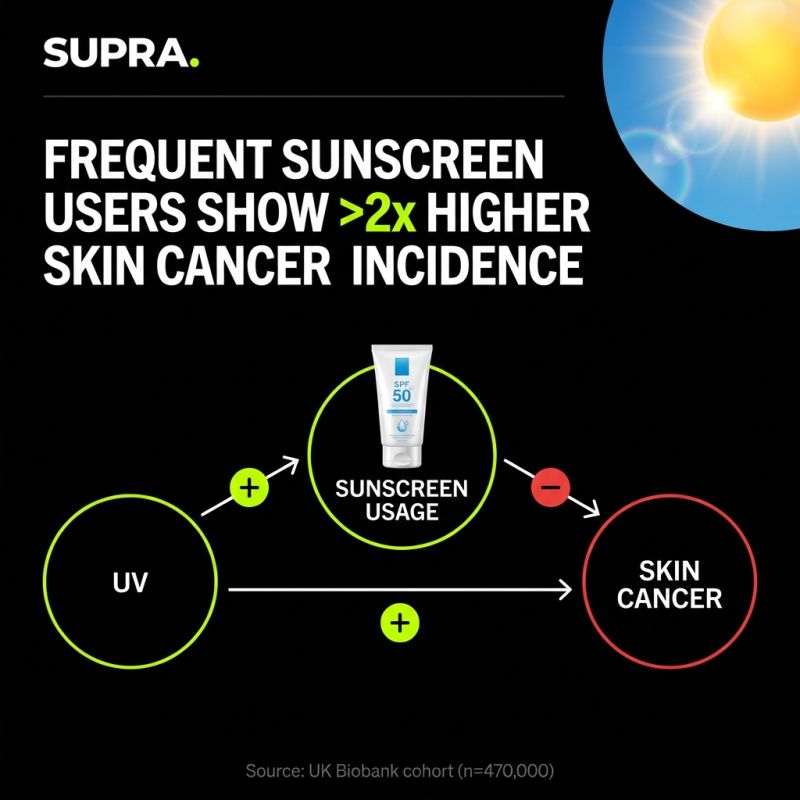
A study with 470,000 people shows not just a significant but a relevant correlation: roughly 2x the cancer incidence among people who use sunscreen.
This is a fact.
But facts like this tell you nothing about cause.
Two facts that seem to contradict each other
Here is the second fact. UV light exposure increases the likelihood of skin cancer. That one is well established.
So now the real question: what is the actual effect of sunscreen?
Sit with that for a second, because it's not obvious. There is very little published causal evidence on it. And the raw correlation, sunscreen users get more cancer, is exactly the kind of number that gets screenshotted, shared, and turned into a headline.
A likely explanation is almost the opposite of the headline. Sunscreen use is caused by exposure. People reach for it precisely because they're spending the afternoon in the sun. So while the sunscreen itself may reduce risk, its use correlates with more UV exposure, and the exposure is what drives the cancer.
The sunscreen didn't cause the cancer. The sun did. The sunscreen just happened to be in the same beach bag.
The same paradox is in your dashboard every day
This is not a story about dermatology. It's the exact pattern I see in business dashboards every single week.
Take a real one. A speaker company noticed that service calls correlated with satisfaction. Customers who called support were more satisfied, not less. Read that quickly and you'd conclude something absurd: to raise satisfaction, generate more support calls.
Wrong remains wrong.
Turns out the people who call are disproportionately new customers. They're excited. They just unboxed the thing. They're calling for installation help, not to complain. The satisfaction was already there, the call didn't create it. Same structure as the sunscreen. A third factor is driving both, and the arrow you assumed runs backwards.
In short: business and marketing decisions need answers to causal questions. "What happens to sales if I move this lever?" Not "what moves alongside sales in the data?"
Why more analysis doesn't save you
Two things quietly corrupt the answer.
Correlation leads you astray. That's the sunscreen problem. And classical statistical modeling doesn't rescue you, because it gets biased by multicollinearity: when your drivers overlap, the coefficients start pointing in directions that are mathematically valid and causally nonsense.
So you can run a bigger regression, add more variables, add more months of data. If the model can't tell a confounder from a cause, you just get a more confident wrong answer. More data from the wrong model is more noise, not more truth.
Before you act on a dashboard, ask:
- Could a third factor be driving both of these variables at once?
- Am I sure the arrow of cause runs the direction I assumed?
- Do my "drivers" overlap so heavily that the model can't separate them?
- If I actually moved this lever, is there any reason to expect the outcome to move with it?
What it actually takes
What's needed is Causal AI, analysis built to estimate what drives an outcome rather than what merely travels alongside it. It separates confounded drivers and estimates the effect of changing one thing while holding the rest steady.
But, and this matters, Causal AI is not a magic box you feed blindly. It needs statistical rigor and real business and marketing expertise to frame the question in the first place. Point it at the wrong variables and you get an elegant, precise, wrong answer. Garbage in, garbage out.
That's the discipline behind our Deep Implicit Research approach: measure what actually moves behavior, then infer cause instead of trusting a coefficient because it looks plausible. It's the same reason most marketing models are wrong. They were never designed to answer the causal question you're using them to answer.
So here's the one question worth pinning above your dashboard.
Are you still correlating, or already explaining?
Correlation vs. causation: frequently asked questions
Does sunscreen cause cancer?
Observational data can show a correlation, one large study of 470,000 people found roughly double the cancer incidence among sunscreen users. But correlation is not cause. A likely explanation is that sunscreen use goes hand in hand with more sun exposure, and UV exposure is a known driver of skin cancer. The sunscreen may reduce risk while still correlating with the higher-exposure group. The raw correlation tells you nothing reliable about the causal effect.
What is the difference between correlation and causation?
Correlation means two things move together in the data. Causation means one actually changes the other. Two variables can correlate strongly because a third factor drives both, because the causal arrow runs the opposite way, or by coincidence. Only causal analysis tells you what happens to an outcome when you deliberately move a lever, which is the only question a decision-maker actually cares about.
Why do marketing dashboards mislead decision-makers?
Because dashboards show correlations and let the reader supply the causal story. Service calls may correlate with satisfaction, but the callers are often new customers who are simply more engaged. Classic statistical models make it worse: with many overlapping drivers, multicollinearity biases the coefficients, so a plausible-looking result can still be wrong. Decisions made on that basis optimize the wrong lever.
How does Causal AI fix the correlation trap?
Causal AI is built to estimate what actually drives an outcome rather than what merely moves alongside it. It separates confounded drivers, handles the overlapping variables that break ordinary regression, and estimates the effect of changing one lever while holding the rest constant. But it is not a black box you feed blindly. It needs business and marketing expertise to frame the question. Garbage in, garbage out still applies.
Dr. Frank Buckler advises leadership teams on growth decisions that depend on why customers choose. He founded SUPRA, holds a PhD in marketing and was among the first to apply causal AI to marketing questions. His latest book is THE TOP 5%.
