


When companies plan AI in marketing, the first question is usually which jobs AI can take over. When you want a prosperous company and create growth – it’s the wrong question. The better question is which knowledge the company holds that demonstrably works, and who keeps it current.
Picture a typical marketing team today. One AI tool writes the ad copy, another builds the landing pages, a third sets up the email sequences. Output has multiplied. Yet the team argues about the same questions as two years ago: Which message makes people buy? Why did the spring campaign work and the fall one did not? Nobody knows for sure, so the AI now produces more of whatever the team believed last year, only faster.
Three simple frameworks explain where AI belongs in marketing, where people belong, and what the real asset of a marketing organization becomes once creating anything costs almost nothing.
1. Two questions decide what AI takes over
For any marketing task, ask two things. First: how well can the know-how behind it be written down, so that a new colleague or an AI could follow it? Second: what does a mistake cost?
Explicit know-how, low to medium risk: automate. Adapting one ad to twelve formats and channels. Writing product descriptions from a spec sheet. Coding 3,000 open-ended survey answers. Adjusting bids within a fixed budget. The rules are known, and an error costs little and gets caught quickly.
Explicit know-how, high risk: collaborate. A price change, a health claim in a pharma ad, a statement during a product recall. The AI drafts and checks against the rules. A person decides and signs off.
Little explicit know-how, high risk: a person does it. Repositioning the brand. Negotiating shelf space with a key retailer. Telling the CEO why the budget should not be cut. The know-how sits in experience and judgment, and a wrong call is expensive.
Little explicit know-how, low risk: experiment. A new social format, a first try at a new channel. Let the AI try things on a small budget and watch what happens.
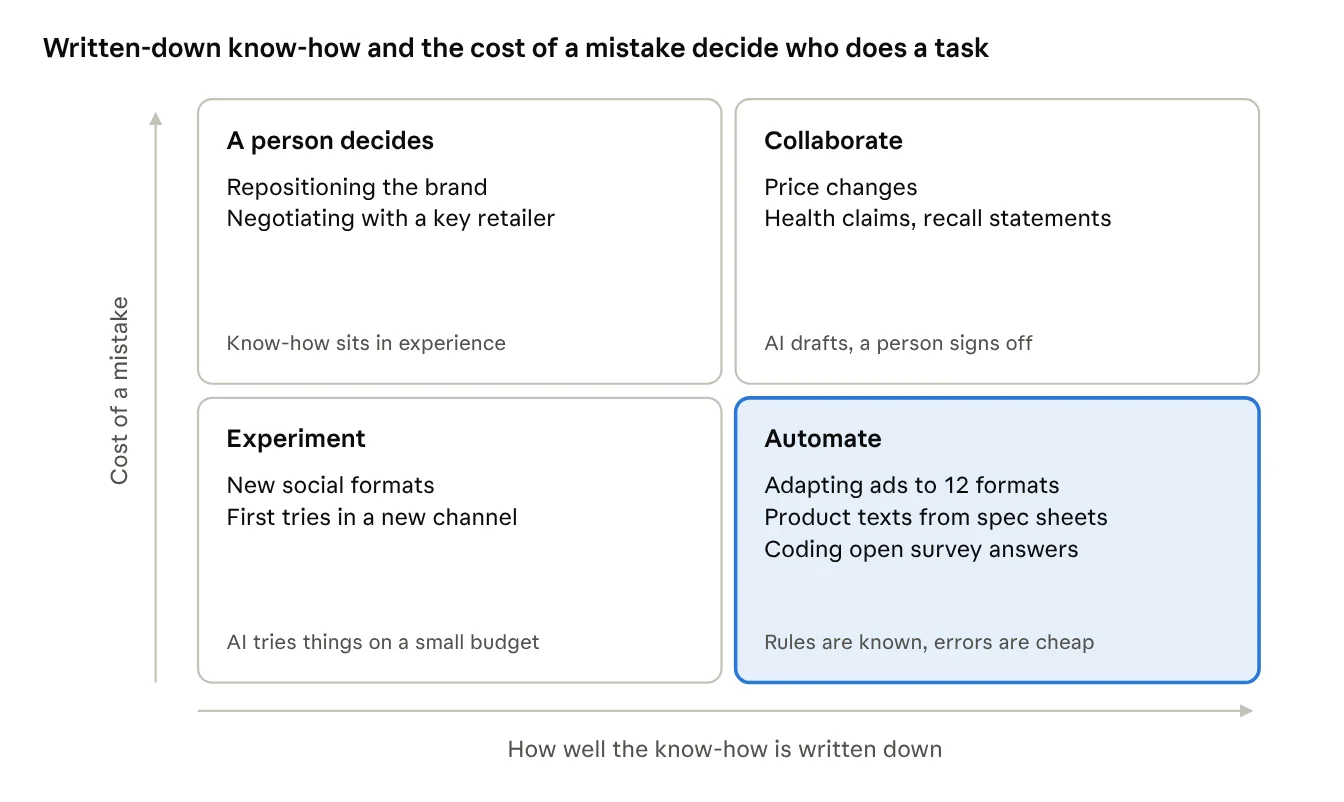
The map is not fixed. Every time someone writes down how a task really works, that task moves to the right. This is the first hint at where the real work of an AI transformation lies.
2. AI automates steps, not jobs
"Will AI replace our brand managers?" is the wrong question, because a job is a bundle of steps. Some steps run on explicit rules. Others depend on tacit knowledge: the things an experienced person knows but has never written down.
Take one job a brand manager does every quarter: launching a campaign.
| Step | Know-how written down? | Cost of a mistake | Who does it |
|---|---|---|---|
| Summarize market data and past results | Yes | Low | AI |
| Find the customer problem worth solving | Partly | High | Person, with AI input |
| Develop the core idea | Partly | High | Person, with AI input |
| Write copy and create visuals in 40 variants | Yes | Medium | AI |
| Adapt assets to all channels and formats | Yes | Low | AI |
| Check legal and brand rules | Yes | High | AI checks, person signs off |
| Build the media plan | Mostly | Medium | AI drafts, person approves |
| Decide what the results mean and what to change | Little | High | Person |
In this job, roughly half of the steps can move to AI. In other jobs the share is far higher. A specialist who manages product feeds and shopping ads may find that almost everything she does follows rules that can be written down. A head of brand strategy will keep most of her work.
So, the useful question for every role is: which steps of this person's week can AI take, and what should the freed-up time go into?
3. Any work has three stages: ideation, generation, validation
Look at marketing from far enough away and every task runs through the same three stages.
Ideation. There is a problem: sales are flat in one segment, a competitor is taking share, a new product needs a market. Someone has to come up with an idea of how to solve it.
Generation. The idea gets turned into something real: a brief, a campaign, a price list, a landing page, a sales script. This is applying known know-how.
Validation. Did it work? And more precisely: did our action cause the result, and will it work again? A campaign that ran during a heat wave can look like a winner in the dashboard while the weather sold the ice cream.
AI changes each stage in a different way.
- Generation gets automated. Producing assets, adapting them, reporting on them: this is where AI is already better and faster than most teams. Note down: Everything around generation, around executing knowledge will be done by AI - 100%.
- Ideation gets multiplied. AI can propose 50 hypotheses in a minute, bring in analogies from other industries and point at patterns in customer comments. Where the problem is well known and the answer has been found before, ideation turns into generation. Cart-abandonment emails are a solved problem; nobody needs a creative workshop for them anymore.
- Validation can be built into a process. A/B tests, holdout groups and regular causal analysis can run as a learning loop: the AI proposes, tests and reports. A person still has to decide which questions are worth testing, what counts as proof, and whether a result is cause or coincidence.
This gives people a clear role: They steer ideation and validation. AI does the generation in between.
4. People move from producing to steering
In this model nobody gets automated away. People hand over the generation work so they have time for the stages that create growth.
What that looks like in a brand manager's week:
- Today: most of the week goes into briefings, asset reviews, agency coordination and building the monthly report. The question of why customers choose the brand gets an hour on Friday, if at all.
- With AI doing generation: on Monday she reviews what last month's tests showed and which assumptions held up. On Tuesday she listens to sales calls and reads customer complaints to find the next problem worth solving. She picks three hypotheses to test. Wednesday she builds an AI that helps her do Monday and Tuesday work in 2 hours. Then she spends Tuesdays improving the quality of knowledge and learnings. The AI builds the variants, runs the tests, modeling and reports back. Her output is fewer assets and more knowledge about what moves customers.
Over time her work will be all about an (AI) system that creates knowledge that works better.
The risk lies on the other side. A team that uses AI only to produce more content, faster, multiplies whatever it already believes. If those beliefs are wrong, the company spends more money on being wrong at scale.
This means automating the generation part without leveraging the validation and ideation part leads to decline not growth.
5. Getting know-how out of people's heads
For generation to move to AI, the know-how behind it has to be written down. Most of it sits in people's heads. The senior copywriter knows which headlines work with German engineers. The key account manager knows what a retail buyer reacts to. The pricing lead knows which discounts customers ignore. None of this is in a wiki, and the wikis that exist are rarely read.
Knowledge management has tried to solve this for 30 years. What is different now is that an AI can run the interview. In my own work I use an AI skill, a structured set of instructions, that walks an expert through five steps:
- Interview. The AI asks how the person does a specific task, step by step, using a real case from the last month.
- Challenge. The AI pushes back on vague rules. "You said emotional headlines work better. For which product? Compared to what? How do you know?" It asks for counterexamples and separates "I have seen this work" from "I believe this".
- Write down. The answers become a draft skill: steps, rules, examples, exceptions.
- Test. The skill runs on a real task. The expert corrects the output, and the corrections go back into the skill.
- Tag. Every rule gets a label: validated, belief, or to be tested. The rules marked "to be tested" go straight into the validation loop.
The result is a skill that colleagues and AI agents can use, plus a list of open questions the company should answer with evidence. The expert work gets in parts freed up. In the same way as blue-collar work had been replaced by white collar work over the last decade.
In the age of AI, we automate knowledge, but we still need “wisdom” to steer a production process that accumulates knowledge. That’s the job of humans.
(The second job of humans in the AI world is to be a human – to build and nurture human relationships. Every human has a natural desire to interact with a human. We are social beings and AI is helping us to live this gift better than ever before. But this is beyond this article)
6. Validated knowledge is the asset that compounds
When every competitor has access to the same AI models, using it to generate answers or content producing content stops being an advantage. What competitors cannot buy is your knowledge of what actually drives your customers' decisions: tested, causal, and current.
An entry in such a knowledge base could look like this:
For first-time buyers of our mid-range model, the message "installs in 10 minutes" raises purchase intent more than "premium quality". Evidence: three tests, Q2 and Q3 2026, plus a driver analysis of 2,400 buyers. Status: validated. Next review: Q2 2027.
Every AI agent that writes copy, plans media or briefs sales can draw on that entry. Every new test adds to it or corrects it. And because markets change, every entry has a review date: what was true in 2023 may no longer hold.
The company still has other assets: the brand, customer relationships, people's personal networks. But validated knowledge is the one that grows with every loop – and that can grow with AI. The job of a marketing organization therefore has three parts: build causal knowledge, extend it, and maintain it. The loop below shows how the pieces from this article fit together.
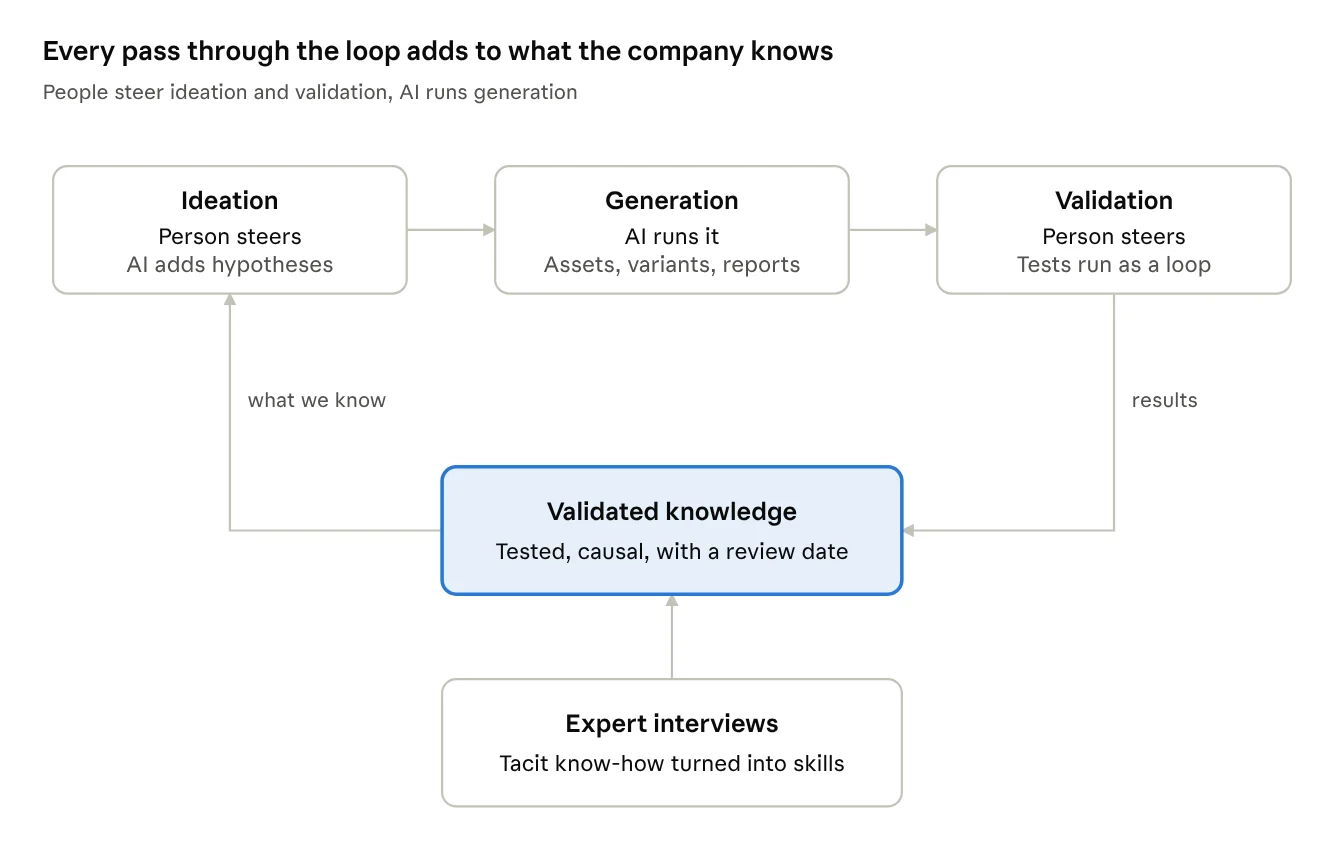
Expert interviews fill the knowledge base at the start. After that, every test and every causal modeling work adds to it or corrects it, and the next round of ideas starts from what the company now knows.
7. AI multiplies what you know, right or wrong
Every company now has access to the same AI models. The effect of AI on growth therefore depends on something the model cannot supply: the company's own know-how about why people buy and which levers work again and again. AI multiplies that know-how. If it is thin, AI produces mediocre output at scale. If it is wrong, AI spreads the mistake faster.
This is the focus of our work at SUPRA. We help companies build the skill set to derive validated causal knowledge, and we treat that skill set as part of the company's intellectual property. Three methods do the work:
- Causal AI analyzes real customer and market data and separates the drivers that cause purchase from those that only appear alongside it. In many data sets, brand awareness and sales rise together. Causal AI shows whether awareness drives sales or sales drive awareness, and by how much.
- Experimental design changes one lever while everything else stays the same. The result can then be traced back to its cause and repeated.
- Implicit measurement captures what drives choice below conscious awareness. What customers say they want and what actually makes them buy often differ. Moving from explicit questions to implicit measurement closes that gap.
These methods can look like academic refinements. In the AI era they are the main lever in creating growth and valuable assets. A company that knows, with evidence, which messages raise purchase intent in its core segment can hand that knowledge to every AI agent in marketing, sales and service. A competitor with the same AI and without that knowledge produces more content, but not more growth.
The model is the same for everyone. The know-how is yours, and the quality of that know-how decides how much your AI is worth.
The Claude Skill you run in your company will be worth more than most of your physical inventory. The process you establish that orchestratess the “manufacturing” of impactful knowledge, the process that updates your AI skills, it will more decide for win or lose than any recruitment decision you make.
8. What a CMO needs to do now
- Understand what the jobs consist of. Break every role in the team into its steps and place each step on the two axes: how well the know-how is written down, and what a mistake costs. This shows where AI can take over today and where it cannot yet.
- Capture the knowledge. Interview the experts the team depends on and turn their know-how into skills that colleagues and AI agents can use. Collect every rule that nobody has tested so far.
- Restructure the jobs. Hand the generation steps to AI, one by one. Redefine roles so that people spend their time on ideation and validation: finding the problems worth solving and identifying what really works.
- Raise the standard of validation. Two numbers moving together on a dashboard prove nothing about cause. Business analytics has to move from reporting correlations to causal analysis. Market research has to move from asking customers what they want to causal driver analysis, experiments and implicit measurement.
- Upskill the team. Causal thinking, experimental design and reading implicit data become core skills in marketing. The intellectual demands on marketers go up, because AI takes the routine work and leaves the hard questions.
- Measure learning. Count validated insights per quarter alongside brand equity to size valuable assets created.
AI already knows the textbooks and the published best practices, and so does every competitor's AI. What it cannot look up is proprietary causal knowledge about your customers. Building that knowledge is the path to growth.
10x Insights
Subscribe to our Thought Leadership Series 10x Insights
New 10x Insights articles by Dr. Frank Buckler, sent to your inbox when they come out.