

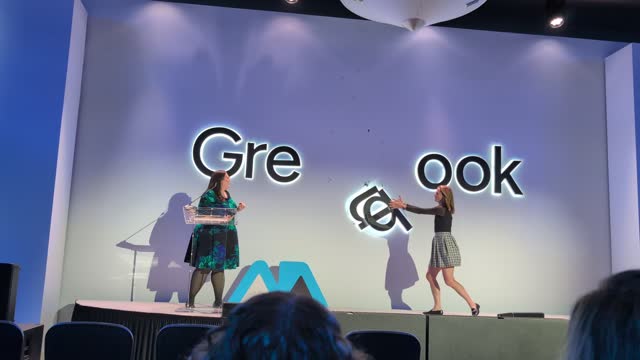
During Megan Peitz's talk at IIEX North America 2026, the big Greenbook sign came down and smashed onto its own logo.
Luckily, nobody was hurt. We all had a great laugh. And to me, it was a perfectly metaphoric moment.
It turned out the big new sign had simply been attached with adhesive strips. Everything worked beautifully on day one… on day two, a butterfly was enough to make the whole thing collapse.
Keep that image in mind. Because it describes the content of that conference, and the current state of the entire insights industry, with uncomfortable precision.
What the Conference Floor Actually Looked Like
Walk the exhibition floor at IIEX NA 2026 and one thing was impossible to miss: roughly 90% of exhibitors were AI tool vendors. The same dominance carried into the presentations.
And nearly every theme, every pitch, every demo reduced to the same three promises:
Faster. Easier. Cheaper.
Let me be fair: that's a legitimate pitch. There is a real use case for "good enough" research. When the question at hand isn't very valuable, businesses rightly want to source the answer for a dime. Nobody should commission a six-figure study to pick the color of a banner ad.
But here's what three decades of working with insights buyers tells me: that use case is massively overrated.
The Trap in the Middle of the Pitch
Call it the Faster-Cheaper Trap: the belief that speed, ease, and cost are what business decision makers ultimately want from research.
They don't. Businesses seldom really need faster, easier, cheaper.
Think about the questions companies actually pay to answer. Should we reposition the brand? Can we raise prices? Will this product sell? Which campaign platform carries the next three years? These are multi-million dollar decisions, and most serious business questions are.
For a multi-million dollar decision, the ultimate goal is not speed. It is truth, precision, and impact.
A wrong answer delivered in an hour is not a productivity gain. It's an accelerated mistake. We've written about what a wrong market research insight actually costs, the research budget is never the expensive part. The decision built on it is.
Of course, some leadership teams are not yet wise enough to value the crucial role of better insights. That's fine. They will learn it the hard way, the market runs that seminar free of charge, and attendance is mandatory.
Adhesive Strips, Everywhere
Now back to the sign.
The sign itself looked great. Big, new, professionally produced. The failure wasn't the sign. It was what attached it to the wall. Adhesive strips: fast to apply, easy to use, cheap to buy. The exact three virtues the industry is currently celebrating.
And that is precisely how most of today's tool innovations are built. Impressive surface. Minimal attachment to the ground truth of why customers actually buy. They will shine on day one, the demo, the pilot, the launch post. And most of them will crash like the Greenbook sign the moment reality applies any pressure.
The agencies riding the same trend face a subtler version of the same fate. When your pitch is "we do what the software does, slightly faster and slightly cheaper", you are not differentiating. You are commoditizing yourself. Everyone competing on the same three adjectives converges to the same price: as low as possible. We've analyzed this dynamic in our look at the alternatives to Kantar, Ipsos, and Nielsen, scale and speed stopped being defensible moats years ago. AI just made it obvious.
What Businesses Will Ask For Instead
Sooner or later, and in my experience, it's sooner than the vendors think, businesses ask a different question. Not "can you do it faster?" but:
"Can you do it better?"
Better means science-backed. Better means answering the deeper question, why customers truly buy, instead of producing quicker summaries of what they say. And the say-do gap guarantees those are not the same thing: the real drivers of buying behavior are largely subconscious and inaccessible to direct questioning, no matter how fast the questioning gets.
That's the standard we build for. Deep Implicit research measures the subconscious associations that actually steer decisions. Causal AI quantifies which of those drivers cause behavior, not which merely correlate with it. Slower than a chatbot summary? Sometimes. Attached with structural anchors instead of adhesive strips? Always.
Before you buy "faster, easier, cheaper", ask this
- What decision will rest on this research, and what is that decision worth?
- Does the method measure what drives behavior, or just summarize what people say, faster?
- Is there any causal validation behind the recommendations, or only plausible correlation?
- If the answer is wrong, what does it cost, and who carries that risk: you or the vendor?
If the decision is worth little, buy the cheap tool with a clear conscience. That's what it's for.
If the decision is worth millions, the arithmetic flips completely: the research cost is a rounding error, and validity is the only variable that matters.
Day Two Is Coming
I don't say any of this with bitterness. The sign falling was genuinely funny, nobody was hurt, and the AI wave will leave the industry better than it found it, after it washes out the adhesive-strip solutions.
But the pattern is as old as the industry: a technology wave arrives, everyone races to the bottom on speed and price, and then the businesses with real money at stake quietly return to the question that never went away, what is actually true about our customers?
On day one, the faster-easier-cheaper tools will shine. On day two, a butterfly lands.
And on that day, we will all have a laugh and go back to the drawing board.
Better beats faster. That is how you 10x your insights.
The Faster-Cheaper Trap: frequently asked questions
What is the Faster-Cheaper Trap in market research?
The Faster-Cheaper Trap is the belief that speed, ease, and cost are what businesses ultimately want from research. AI tool vendors dominate industry conferences with exactly this pitch. But most business questions sit behind multi-million dollar decisions, where the real goal is truth, precision, and impact. Tools and agencies competing only on faster-easier-cheaper shine on day one, and collapse like a sign hung with adhesive strips.
When is "good enough" AI research acceptable?
When the decision at stake isn't very valuable. For low-stakes questions, businesses rightly want to source answers for a dime, and fast, cheap AI tools serve that use case fairly. The trap is treating this as the main market: in practice the use case is overrated, because the questions companies actually pay to answer, pricing, positioning, launches, carry multi-million dollar consequences and demand decision-grade validity, not speed.
Why will agencies riding the AI trend commoditize themselves?
Because when everyone competes on the same dimensions, faster, easier, cheaper, the only remaining differentiator is price, and margins race to the bottom. An agency whose pitch is identical to a software subscription will eventually be replaced by one. The escape is to compete on validity: science-backed methods such as Causal AI and implicit measurement that answer the deeper question of why customers truly buy.
What should insights leaders demand instead of faster and cheaper?
Better. For decisions that move millions, leaders should demand research that is science-backed, causally valid, and precise, evidence of what drives behavior, not quicker summaries of what people say. SUPRA's Deep Implicit research framework and Causal AI are built for exactly this: measuring the subconscious drivers of buying behavior and quantifying their causal impact, so the decision resting on the research holds up on day two.
Dr. Frank Buckler advises leadership teams on growth decisions that depend on why customers choose. He founded SUPRA, holds a PhD in marketing and was among the first to apply causal AI to marketing questions. His latest book is THE TOP 5%.
