

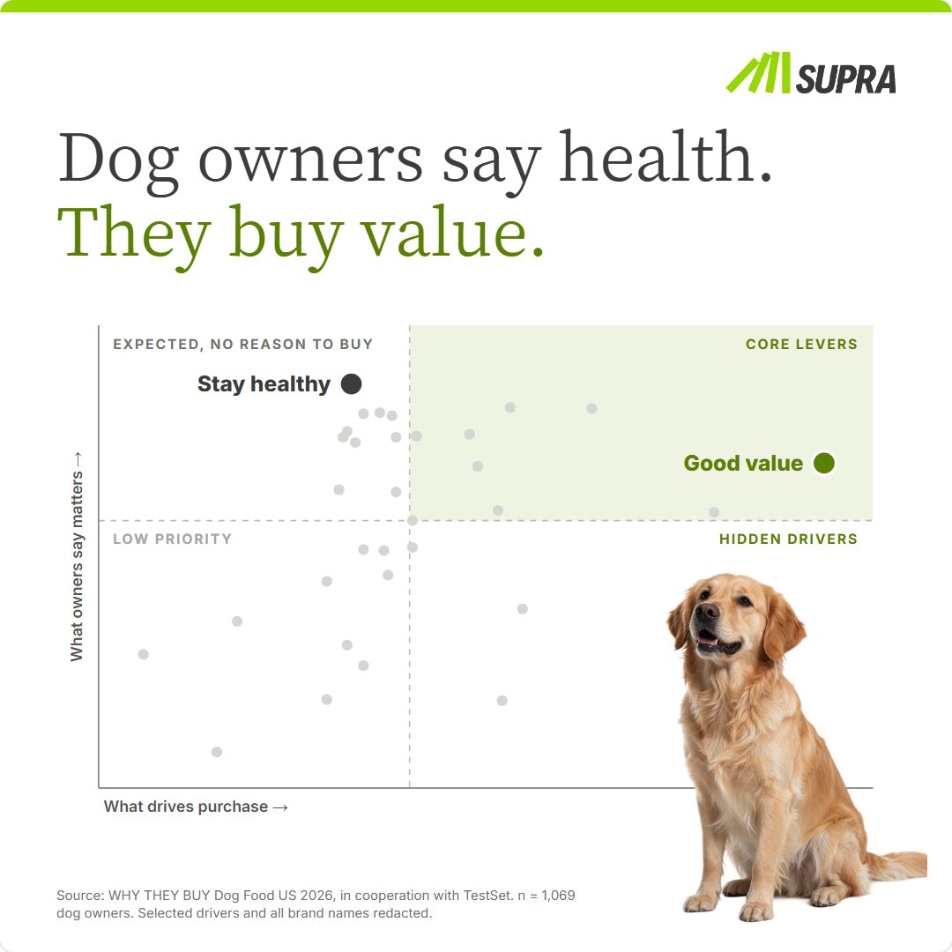
What customers rank as most important is often not what makes them buy.
1,069 US dog owners ranked 32 goals. "Stay healthy" came out on top. Then we ran the driver analysis. Health barely moves what they buy.
That is the difference between stated importance and purchase impact. Most priority lists I get to see are built on the first one.
Why are our customer surveys showing different results than sales?
Because the survey and the sales data measure two different things, and neither of them measures why people choose.
Surveys measure what people say matters. MMM (marketing mix modeling) and attribution measure where the money went. Neither shows why someone picks one bag of dog food over another.
Ask a dog owner what matters and you get the reasonable answer. Health, of course. Who would say anything else about their dog? The answer is honest. It just isn't the reason for this bag and against that one.
It's like asking people what matters in a restaurant. A clean kitchen, everybody says so. Mmh. And when did you last pick a restaurant because of its kitchen?
Sales data has the opposite problem. It shows what was bought and what you spent to get there. The why is not in it.
So the survey says health, you build the plan on health, sales don't follow, and two departments argue about who has the wrong numbers. Both have correct numbers. They answer different questions. This is the say-do gap on the scale of one category, and it is why customers can't tell you why they buy.
What is the difference between stated importance and derived importance?
Stated importance is what people tell you matters when you ask them directly. Derived importance is how strongly something moves the outcome you care about, calculated from data and never asked for.
Three terms, defined once so nobody in your meeting has to nod and google later.
Stated importance is the rank or rating a customer gives a goal or a feature when the question is "how important is this to you?" In our study that is the ranking of the 32 goals, with "stay healthy" first.
Derived importance is not asked. You measure how customers see a product on each goal, you measure what they buy or would buy, and you calculate how much each goal moves that purchase. A goal can rank first when stated and barely register when derived. Health in dog food did.
Key driver analysis is the name of that calculation. For every goal or attribute it estimates how strongly it drives the outcome: purchase, preference, loyalty. How we run it is on the key driver analysis page.
One warning. Derived does not automatically mean true. Many driver analyses are a correlation with a nicer name, and correlation leads astray when the drivers are tangled up with each other. So ask of any driver analysis whether it explains what causes purchase or only shows what moves together with it.
What 1,069 dog owners said, and what they buy
The study is WHY THEY BUY Dog Food US 2026, run in cooperation with TestSet, n = 1,069 dog owners. These are the reported results:
- Owners ranked "stay healthy" as their most important goal out of 32.
- In the driver analysis, "stay healthy" barely moves what they buy.
- The strongest driver is good value. It is almost three times as strong as complete nutrition.
- Value in turn comes mostly from two feelings: having made a smart choice, and being proud of that choice.
Stop at the last line. "Value" sounds like price. In this data it is mostly a feeling. I chose smart, and I'm proud of it. Whoever reads "value" as "cheaper" misses most of what is in it.
The chart puts the goals on two axes. Upwards: "What owners say matters". To the right: "What drives purchase". That gives four fields.
- Expected, no reason to buy (top left). Owners call it important, but it does not drive purchase. "Stay healthy" sits here.
- Core levers (top right). Owners say it matters and it drives purchase. "Good value" sits here.
- Low priority (bottom left). Neither said nor driving.
- Hidden drivers (bottom right). The drivers nobody names in a survey.
The public version of the chart has selected drivers and all brand names redacted. So I won't name the hidden ones here.
How do I read the top left field? Its name says it. Owners expect health. What is expected is no reason to pick one bag over the other. That does not make health unimportant to them. It makes it a weak place to put the money that is supposed to move purchase.
And the bottom right field is the one a survey can never fill. If nobody names a driver, no ranking question will ever show it to you.
Checklist: do your priorities stand on stated importance or on purchase drivers?
Six questions for your next planning round.
- Where does the number one on your priority list come from? If the source is a ranking or rating question, it is stated importance.
- Do you have one number per goal, or two? With only "how important" you have one axis. The four fields need both.
- Is your top priority something customers simply expect in your category? Then check whether it is a reason to choose you at all.
- Can anyone on the team say what your strongest driver is made of? In our study, value came mostly from two feelings. A driver you can't take apart, you can't brief.
- Does anyone quote MMM or attribution as the answer to "why do they buy"? Those tell you where the money went.
- Is there anything in your bottom right field? If every driver on your list is one customers named themselves, nobody has looked for the hidden ones.
Question 1 does most of the work. If the trail ends at "we asked them," the rest of the list is a decorated guess.
What it looks like when a company acts on what customers really long for, and not on the attribute everyone names first, is in the T-Mobile growth lesson.
Stated importance vs. purchase drivers: frequently asked questions
How do I find out what really drives purchase in my category?
You measure two things for every goal and then connect them: how customers see you on that goal, and what they buy. A key driver analysis calculates from this how strongly each goal moves purchase. Two conditions decide whether the result is worth anything. First, the list of goals has to include what people don't say on their own, which is the job of deep implicit research. Second, the analysis has to separate cause from correlation.
Should we keep driver analysis in-house or hire an agency?
Who runs it matters less than how it is run. If the analysis rests on asking customers what is important, you get stated importance, whoever's logo is on the slide. Ask anyone who offers a driver analysis, inside or outside, two things: how do you find the drivers nobody names in a survey, and how do you separate cause from correlation?
What is key driver analysis?
Key driver analysis estimates how strongly each goal or attribute drives an outcome such as purchase. Its result is derived importance, as opposed to the stated importance you get from asking "how important is this?" In the WHY THEY BUY Dog Food US 2026 study (in cooperation with TestSet, n = 1,069), the two disagree clearly: "stay healthy" ranks first of 32 goals when stated and barely moves purchase in the driver analysis.
Why do dog owners buy one dog food over another?
In the reported results of WHY THEY BUY Dog Food US 2026 (in cooperation with TestSet, n = 1,069 US dog owners), the strongest purchase driver is good value, almost three times as strong as complete nutrition. Value comes mostly from two feelings: having made a smart choice, and being proud of that choice. "Stay healthy" is the goal owners rank as most important, but it barely moves what they buy.
Dr. Frank Buckler advises leadership teams on growth decisions that depend on why customers choose. He founded SUPRA, holds a PhD in marketing and was among the first to apply causal AI to marketing questions. His latest book is THE TOP 5%.
