

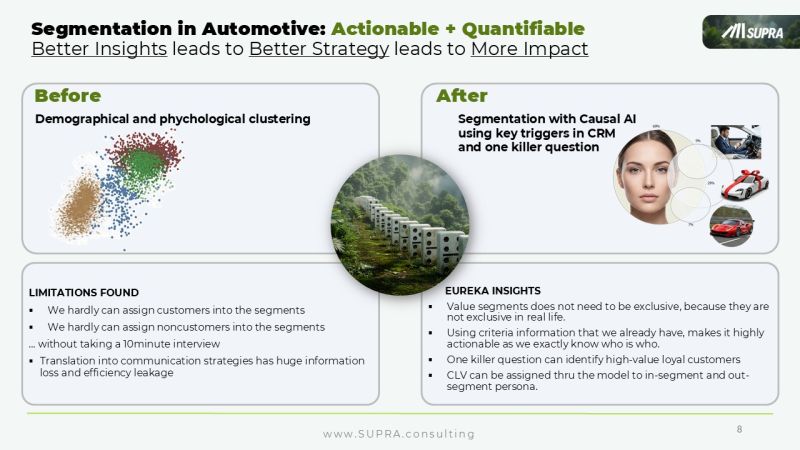
Segmentation fails at exactly the point where it should create impact: activation.
Not in the workshop. Not in the persona posters. Not in the steering committee that approved it.
In the CRM system. In the sales call. In the email campaign that was supposed to speak to "Ambitious Achievers" and had no way of knowing who they were.
The Sophistication Trap
Demographic and psychographic clusters look sophisticated. Six segments, richly described. Attitudinal dimensions, value systems, lifestyle statements. The deck feels like deep customer understanding.
Then someone asks the operational question: "Which segment is this customer in front of me?"
Silence.
Psychographic segments are built from 20-minute survey batteries. Your CRM doesn't contain survey batteries. Your sales team can't administer one mid-conversation. Your ad platform certainly can't. So the segments exist in research, and nowhere else. That's the first failure: the segments are hard to operationalize inside CRM, sales, and communication workflows.
But here's the uncomfortable part…
Even if you could operationalize them, most of these segmentations wouldn't work. Because they suffer from a deeper flaw: they're built on correlation, not root causes.
Clustering finds customers who look similar. It doesn't ask why they buy. If the attributes defining a segment don't cause different behavior, then treating the segment differently changes nothing. You've painted racing stripes on a parked car.
The Fix: Behavioral Triggers + Causal AI
There's a more effective approach, and it inverts the usual logic. Instead of starting from who customers are, start from what customers do, and let causality decide what matters.
Three steps:
Segmentation that survives contact with reality
- Use observable behavioral triggers. Actions, signals, choices, data you actually have or can realistically get for every customer and prospect. Not self-reported lifestyle statements.
- Combine them with Causal AI. Causal AI separates the triggers that drive different buying behavior from the ones that merely co-occur with it. This is the same causal logic that powers key driver analysis, applied to segment discovery.
- Identify segments through a small number of decisive signals. Not forty variables. A handful. Few enough that assignment is instant, robust, and automatable.
Why does this work where traditional segmentation fails? Because every design choice is disciplined by one question: can the organization act on this tomorrow morning?
A segment defined by three observable signals can be scored in your CRM tonight. A segment defined by a latent attitudinal factor cannot, not tonight, not ever.
What You Get When Segments Are Causal
The result, proven in real-world consulting projects, is a segmentation with four properties that traditional approaches almost never deliver together:
Measurable. Segment membership is computed from data, not divined from vibes. You can count your segments, track their movement, and audit the assignment.
Directly actionable. Each segment maps to concrete treatment: which offer, which message, which service level. Because the defining signals are causal, the treatment actually moves behavior. This matters just as much on the retention side, the same logic reveals what causally drives churn, segment by segment.
Assignable to real customers and prospects. Not just survey respondents. Everyone in your database, and everyone who enters it tomorrow. This is the difference between a research artifact and an operating system for growth. It's also the natural evolution of motivation-based segmentation: motivations discovered in research, activated through observable signals.
Connected to CLV and business outcomes. Because causal segments predict behavior, each segment carries known economic consequences. You can prioritize activation by expected value, not by which persona has the most charming illustration.
The Killer Question
Now the part I find genuinely beautiful.
When Causal AI isolates the few signals that truly drive buying behavior, something remarkable becomes possible: compression.
Sometimes one killer question creates more value than a 20-minute survey.
Read that again. One question, the right question, can assign a customer to the segment that predicts their behavior better than a battery of forty items. Because the forty items were measuring correlations. The one question measures the cause.
Think of it like a doctor's diagnosis. A bad doctor orders every test in the catalog and drowns in the results. A great doctor asks the one question that discriminates between the possibilities. The great doctor isn't lazier…
She understands the mechanism.
Causal AI is a technology that can find the single question you should ask each of your customers. Onboarding flows, sales conversations, service calls, suddenly every touchpoint becomes a segmentation engine, at the cost of one question. No 20-minute survey. No typing tool nobody uses. One decisive signal, captured where the customer already is.
The best segmentation isn't the one with the richest descriptions. It's the one with the shortest path from signal to action.
Stop Admiring Your Segments. Activate Them.
Here's the test for any segmentation on your shelf: can your CRM assign a new customer to a segment automatically, today, from data you already collect?
If yes, congratulations, you have an activatable segmentation. Now verify the segments are causal, so acting on them actually changes outcomes.
If no. You have a very expensive piece of customer literature.
The path forward isn't more sophistication. It's less: fewer signals, causally chosen, operationally embedded. Behavioral triggers in, Causal AI on top, decisive signals out.
This is how you 10x your segmentation.
Segmentation activation: frequently asked questions
Why does segmentation fail at activation?
Because demographic and psychographic clusters, however sophisticated they look, are hard to operationalize inside CRM, sales, and communication workflows. You can't reliably assign real customers to them. Worse, they are built on correlation rather than root causes, so even when activated, treating segments differently doesn't change behavior. The fix is building segments from observable behavioral triggers validated with Causal AI.
What are behavioral triggers in segmentation?
Behavioral triggers are observable actions and signals, things customers demonstrably do, used as the raw material for segmentation instead of stated attitudes or demographics. Combined with Causal AI, which identifies the small number of decisive signals that actually cause different buying behavior, they yield segments that are measurable, directly actionable, and assignable to real customers and prospects.
What is a killer question in customer research?
A killer question is the single question whose answer assigns a customer to the right segment better than a long survey battery. Causal AI makes this possible: by isolating which few signals causally drive buying behavior, it can compress segment identification into one or two data points. Sometimes one killer question creates more value than a 20-minute survey, and it's a question you can realistically ask every customer.
How do causal segments connect to CLV and business outcomes?
Because causal segments are defined by drivers of behavior, membership predicts what customers will do, buy more, churn, trade up, not just who they resemble. In real-world consulting projects, this makes segments connectable to customer lifetime value and business outcomes: each segment carries known behavioral consequences, so activation decisions can be prioritized by expected value rather than by persona aesthetics.
Dr. Frank Buckler advises leadership teams on growth decisions that depend on why customers choose. He founded SUPRA, holds a PhD in marketing and was among the first to apply causal AI to marketing questions. His latest book is THE TOP 5%.
