

Ever sought a second opinion from a doctor?
Most of us have. Before a major operation, it's the obvious move. Nobody calls it distrust. Nobody's surgeon takes offense. It's simply what rational people do when the stakes are high and the diagnosis is hard.
Now the follow-up question: have you ever sought a second opinion from a specialist consultant, for example, after a strategy phase led by a top MBB consultant?
Almost nobody has. Think about what that means.
Companies routinely double-check a knee operation… and single-source the strategy that will steer hundreds of millions in investment.
The Economics Are Absurd, In Your Favor
Let's talk numbers, because the numbers make this decision for you.
Top management consultants cost a fortune. A growth strategy often runs to €1 million. That buys you brilliant people, polished frameworks, and a deck your board will love.
As a boutique consultancy, SUPRA takes a more efficient approach, which is why a full growth strategy from us often costs much less than €300k. I know what you're thinking: €300k for a consultancy nobody has heard of feels risky. Fair. I'd think the same. (Though if the comparison interests you, I've written up how a Causal AI boutique stacks up against a Simon-Kucher-style firm.)
But here's the thing: you don't have to start there.
Getting started is easier than you might think. A second-opinion project can be carried out for as little as a low five-figure sum.
Run the asymmetry. On one side: minimal additional cost, a rounding error next to the strategy fee, let alone the execution budget. On the other: potentially valuable insights about the single document that will direct your company's next years.
It's actually a no-brainer. The only reason it's rare is that nobody made it a habit.
The Kicker: Impact Is a Chain Reaction
Now, the part that turns "nice idea" into "necessary."
Impact is the result of a chain reaction, any weak link kills it.
A strategy creates results only if every stage holds: the insights are right, the conclusions follow from the insights, the initiatives follow from the conclusions, the execution follows the initiatives. Break one link and the value of the whole chain drops to zero. Not to eighty percent. Zero. You're now executing, consistently and expensively, in the wrong direction.
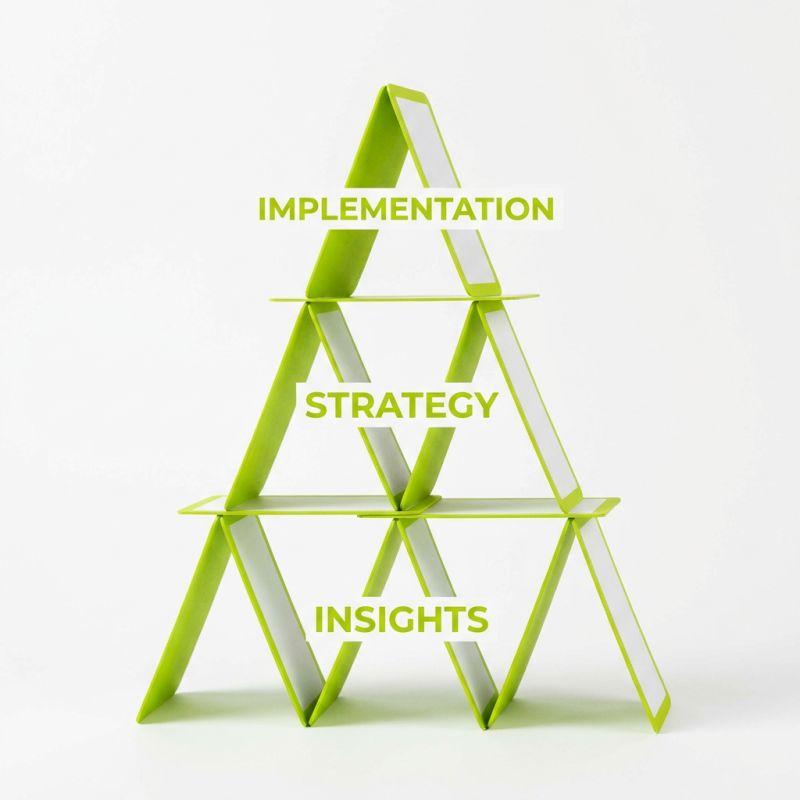
Or use the house-of-cards metaphor: any strategy can only be as good as the degree to which the insights it builds on precisely describe the causal mechanisms of your market and your customers. The top card is the strategy. The bottom cards are the insights. Nobody inspects the bottom cards, because the top card is so beautifully drawn.
So where is the weak link in a typical MBB engagement?
Not in the intellect. Not in the frameworks. It's here: consultants typically use external research agencies to get their insights. They are not leading insights experts themselves.
Those agencies are good at their craft. Genuinely. But they do not excel beyond traditional insights quality, surveys that record what customers say rather than what drives them, analyses that report correlations rather than causes. Conventional inputs, methodically collected. The strategy on top inherits every one of their blind spots, with a €1m stamp of confidence on the cover. That inheritance has a price, and it compounds.
The 5% Problem
You can see the consequence of this weak link at market scale. The numbers are brutal:
What traditional insights quality produces
- Just 5% of brands grow sustainably. The other 95% cycle through strategies, agencies, and CMOs.
- Only 5% of innovations survive. Most were validated by research that measured polite stated intentions, not real demand.
- Only 5% of ad campaigns create significant growth. The rest optimize metrics that never had a causal link to sales.
Ninety-five percent failure rates, everywhere you look. And here's the diagnosis most people miss: everyone is using the same research, from the same types of agencies, with the same methods.
Using insights and research that everyone uses is holding brands back.
It cannot be otherwise. Identical inputs produce identical strategies. Identical strategies produce the 95%. If your evidence comes off the same shelf as your competitors', the Kantar-Ipsos-Nielsen shelf, your strategy is a variation of theirs, whatever the deck says about differentiation.
Why We Refuse to Outsource Insights
This is the conviction SUPRA is built on: research and insights excellence is a core part of strategy consulting. So crucial, it's impossible to outsource.
The doctor analogy holds one more time. A great surgeon who outsources the diagnosis to the cheapest lab isn't a great surgeon. Diagnosis and treatment are one discipline. Separate them, and the scalpel work is precise while the patient gets operated on for the wrong disease.
So we kept them together. Our strategy work runs on our own instruments: Deep Implicit Research to access the subconscious motives customers can't articulate, and Causal AI to establish which drivers actually cause behavior instead of merely correlating with it. The insights layer isn't a subcontracted input to our strategy. It is the strategy work, the part that decides whether every card above it stands or falls.
That's also exactly what a second opinion from us examines. We don't re-run the MBB engagement. We stress-test its foundation: do the insights beneath the recommendations describe the true causal mechanisms of your market? Sometimes the answer is yes, congratulations, you now have certainty that was worth every cent. Sometimes the answer reveals a weak link… before the execution budget finds it for you, in public, eighteen months from now.
Either outcome is worth a low five-figure sum. Only one of them is available after you've committed.
The No-Brainer, Restated
You wouldn't accept a single diagnosis before major surgery.
Your strategy deserves the same skepticism. Minimal additional cost. Potentially decisive insight. A foundation check on the house of cards before you move in.
Get the second opinion.
This is how you 10x the odds that your strategy joins the 5%.
Strategy second opinions: frequently asked questions
What is a strategy second opinion?
An independent specialist review of a growth strategy, usually after a strategy phase led by a top consultancy. Like a medical second opinion, it doesn't redo the whole treatment; it stress-tests the diagnosis. SUPRA focuses on the weakest link: whether the insights the strategy builds on accurately describe the causal mechanisms of your market and customers, using Causal AI and Deep Implicit Research rather than traditional survey evidence.
How much does a second-opinion project cost compared to a full strategy?
A growth strategy from a top (MBB) consultancy often runs to €1 million. As a boutique consultancy, SUPRA delivers growth strategies for typically well under €300k. A second-opinion project is far smaller still: it can be carried out for a low five-figure sum. Set against the size of the decisions at stake, the additional cost is minimal, which is why it's essentially a no-brainer.
Why would a strategy from a top consultancy have weak insights?
Because top consultants typically outsource insights to external research agencies. Those agencies are good at their craft, but they don't excel beyond traditional insights quality, stated answers and correlational analysis. Since impact is a chain reaction where any weak link kills it, a brilliant strategy on conventional insights inherits their blind spots. That's why SUPRA treats insights excellence as impossible to outsource, and why a wrong insight costs far more than the research did.
When should I get a second opinion on my strategy?
Before you commit serious money to executing it. The natural moment is at the end of a strategy phase, when recommendations exist but budgets aren't yet spent. It's also warranted whenever a strategy rests mainly on survey-based, stated-preference research, or when recommendations feel plausible but nobody can explain the causal mechanism behind them. Given that just 5% of brands grow sustainably, checking the foundation is cheap insurance.
Dr. Frank Buckler advises leadership teams on growth decisions that depend on why customers choose. He founded SUPRA, holds a PhD in marketing and was among the first to apply causal AI to marketing questions. His latest book is THE TOP 5%.
